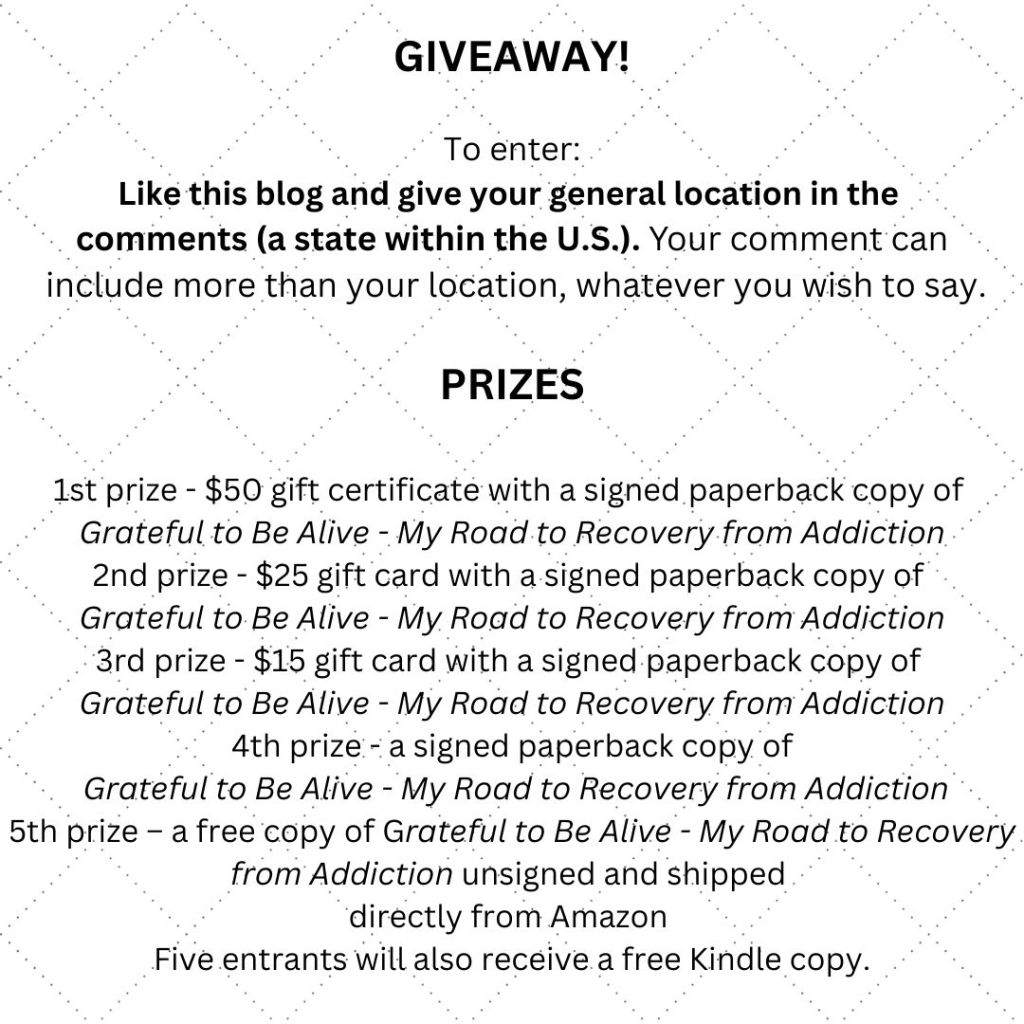
1st prize – $50 gift certificate with a signed paperback copy of Grateful to Be Alive – Winner: Scott Wade 2nd prize – $25 gift card with a signed paperback copy of Grateful to Be Alive – Winner: Jason T. Masters 3rd prize – $15 gift card with a signed paperback copy of Grateful to Be Alive – Winner: Patrick Mullikin 4th, 5th, and 6th prize – a signed paperback copy of Grateful to Be Alive – Winners: Dominick Petrellese, Genevieve Strathman Snow, and Jack Lyons
Congratulations to the winners, and thank you all so much for participating. Above all, thank you for your support, enthusiasm, and encouragement. You have no idea how much I appreciate it! It means the world to me.
I will also post these results on Facebook and attempt to notify winners by e-mail or private message.
If you’ve won a paperback copy of my book, I will need a home or P.O. address to mail it to you. If you’ve won a Kindle copy of the book or a gift card, I will need your e-mail address. Please message me the information on Facebook or send it to me at dksanz@yahoo.com.
“Kristina went dancing at a club in the Bronx with a friend. Upon their return, they talked in the car for a while. Of course, it was pitch-dark by then and eerily quiet when, quite suddenly, a man crept out of the shadows, aiming a .44 revolver at point-blank range. He didn’t know them, but they were his target. One of several shots he fired hit Kristina in the head. In an instant, she slumped over and collapsed onto the pavement. She had no time to scream, and I doubt she ever noticed him. But, just like that, she was dead. A friend called me at work to break the news. Before I could put the phone down, all eyes were on me—the eyes of shocked and curious coworkers gauging my reaction. Speculation ensued within earshot. ‘Maybe it was a mob hit. Her family’s Italian.’ ‘What was she doing out at two o’clock in the morning?’ It infuriated me that Kristina’s integrity was in question because she was the victim. I was stunned into silence. I had chills. But despite the crushing pain, I didn’t cry until later, when the distress made me wonder again about the divine protection we so naïvely expected. Why Kristina? I had to ask. Why anyone? But why Kristina?”
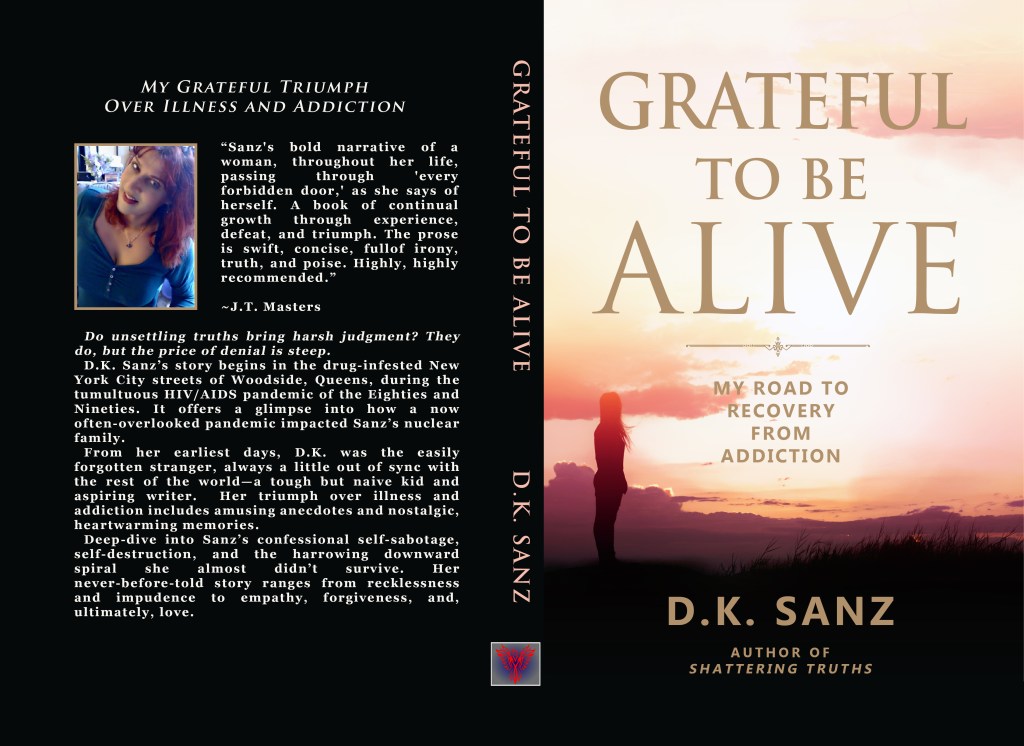
Grateful to Be Alive
My Road to Recovery from Addiction
by D.K. Sanz
Do unsettling truths bring harsh judgment? They do, but the price of denial is steep.
D.K. Sanz’s story begins in the drug-infested New York City streets of Woodside, Queens, during the tumultuous HIV/AIDS pandemic of the 80s and 90s. It offers a glimpse into how a now often-overlooked pandemic impacted Sanz’s nuclear family.
From her earliest days, D.K. was the easily forgotten stranger, always a little out of sync with the rest of the world—a tough but naïve kid and aspiring writer. Her triumph over illness and addiction includes amusing anecdotes and nostalgic, heartwarming memories.
Grateful to be Alive delves deep into Sanz’s confessional self-sabotage, self-destruction, and the harrowing downward spiral she almost didn’t survive. Her never-before-told story ranges from recklessness and impudence to empathy, forgiveness, and love.
D.K. has since published several books, primarily poetry but also a novel, and she continues to work on sequels and an all-new fantasy series. You’ll find some of her poetry at the end of this book.
Whether struggling or not, you will find Grateful to Be Alive is a story of hope, defying insurmountable odds, finding joy, and a gradual transition toward authenticity and becoming the person D.K. always wanted to be.
“When you begin this book, you will not put it down. You will immediately be drawn into Sanz’s bold narrative of a woman, throughout her life, passing through “every forbidden door,” as she says of herself. It is a book of continual growth through experience, defeat, and triumph. The prose is swift, concise, full of irony, truth, and poise. You will not find a more startling, revealing memoir. Highly, highly recommended.” ~ Jason T. Masters
If you are interested in obtaining an ARC copy, please e-mail me at dksanz@yahoo.com.
No purchase is necessary to enter or win, and purchases of books by D.K. Sanz do not enhance an entrant’s chance of winning.
This contest is limited to the United States, void where prohibited, and off-limits to the author’s immediate family members. You must be 18 years old to enter.
By participating in this contest, you agree to the terms and rules and refrain from fraudulent claims, including submitting multiple entries using alternate e-mail addresses. Violation will result in disqualification.
I will provide a complete list of winners on this blogon March 25.
Winners must provide the info to claim their prizes by April 1. Failure to do so will result in disqualification.
The sponsor of this campaign is Moonlit Dawn Publications, LLC. This contest is in no way sponsored, endorsed, administered by, or associated with Facebook, Instagram, Twitter, Word Press, or any other social media site.
By entering, you agree to release and hold harmless Moonlit Dawn Publications and its representatives from any liability.
Moonlit Dawn Publications is not liable for a winner’s failure to receive notices. Please check your spam/junk mail and security settings.
Moonlit Dawn Publications may terminate or cancel this campaign if necessitated by circumstances beyond our control.
How many times can we try and try again, hoping things will be different? Sometimes, the people we think are ports in a storm turn out to be the rips in our sail.
The truth is, most of us have precarious relationships with others where we find ourselves setting or accepting boundaries to maintain that connection. Maybe it’s an intolerable behavior issue or substantial differences of opinion. There are situations, too, where people grow up with devastating trauma. Family members have different outlooks about what happened, maybe even different experiences. One may still feel the agony of the hurt they or someone else caused in doing what they felt was right. Things said may remind you of the pain they caused you or the pain you caused them.
These situations are loaded for the simple reason that you care about these people. If you didn’t, you could easily blow them off and never have anything further to do with them.
And sure, it’s painful. You wish things were different. It saddens us that there was so much good, and we cherish the memories to the point of tears. We may wonder, Can we ever get it back? If we did, would it ever be the same?
What I’ve found is, when considering forgiveness in any situation, a critical thing to decipher is, What really happened? Sorting out what’s true and what’s not is more important than appeasing others who need to deal with their own wounds. Their place in the healing process is different from ours. Denial has consequences for both parties, so did we play a part in the conflict? If so, what was it? We can take responsibility only for what we contributed to the falling out.
Maybe the falling out stemmed from an argument, someone else’s meddling, or someone’s denial. Perhaps it was because of lies and fragile egos, smear campaigns, and the rush to judgment.
Whatever it was, for any kind of resolution, both parties have to come to the table with an open mind. There must be a willingness to walk hand in hand through that minefield together. It’s hard because, quite often, the trust isn’t there any longer. And you have to be willing to trust someone to do that.
There’s a difference, too, between reaching out and setting a trap. We can’t be condescending or aim to “win.” We have to be genuine and sincere, let go of any bitterness or resentment, and respond only from a place of caring and love. You can have so much love for someone and still have to handle your interaction with them like you’re holding a piece of glass.
There are no-fly zones in these situations. Believe me, there was a time I’d have flown my plane right into that restricted zone and not for a moment realize the potential damage I’d cause to the relationship. I’d gotten used to a cycle of being hurt and fighting back. Sometimes, we are blinded by rage, and we keep hurling it at someone, but we don’t realize they’re bleeding, too.
These days, I think of what I might say in these circumstances and recognize how it could go wrong. Often, I decide I can say nothing. Or I wonder how to rectify a situation or resolve a conflict, and every way I might think to approach it, I see a flashing red light, and it’s just no. Don’t. You can’t. There’s a need to tread gently, take care.
Plenty of people out there can discern these situations, I’m sure, but many of us had to learn.
No doubt, it’s wonderful when the resolution of a conflict results in mutual forgiveness and a starting point for healing the relationship. At the same time, we can’t allow people to deny the reality of what we experienced, and we can’t accept their spin on it if it has no basis in truth. We don’t want to hear the justification for what cannot be justified, or for the other party to minimize the damage. We can’t let them guilt or shame us into keeping quiet or making concessions.
Sometimes, however, their message is clear. Maybe it’s always been clear, but it takes a while for us to accept. Their words and actions have repeatedly shown us they are not in our corner. They may not be against us, exactly, but they’re not for us either. They don’t respect us or our boundaries. They’re not concerned about our feelings. Nothing’s ever truly resolved in a relationship like that, and nothing changes.
We lost this person long ago, and it has already broken our hearts a thousand times. Is this someone we ever really had or truly knew? We lost the chance to dysfunction, and not even obligatory love and commitment could save it. It’s reached a point where suiting up and showing up simply hurt too much.
It hurts to admit when we’ve chosen someone or something that isn’t right for us, and when we’re trying to fit where we don’t belong.
And, for various reasons, not everyone is in a position where they can simply walk away. There may not even be a lot they can do to protect themselves or limit interaction. They may not be able to avoid participating in the drama.
Those of us who do walk away will often mourn what we couldn’t have. Some holes remain unfilled for us. Some stories will never be heard or told, and some scars won’t ever heal. We say goodbye with so much weight and with a burden too hard to hold. It’s more than sorrow. It’s grief. And you miss what you wanted that to be.
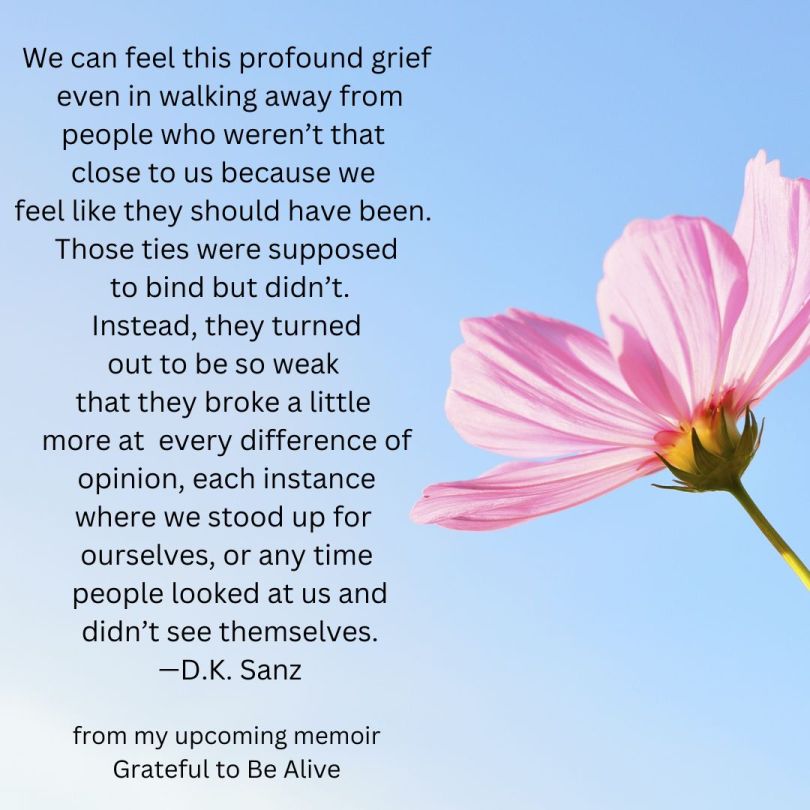
We can feel this profound grief even in walking away from people who weren’t that close to us because we feel like they should have been. Those ties were supposed to bind but didn’t. Instead, they turned out to be so weak that they broke a little more at every difference of opinion, each instance where we stood up for ourselves, or any time people looked at us and didn’t see themselves.
We certainly do a lot of grieving in life, and grieving does have its beauty. We can experience joy, happiness, sadness, and hurt; none are permanent states. These are moments that awaken us.
I’ve learned that the pain that follows in walking away is worth getting that toxicity out of your life. Even if they create a false narrative about you and make you out to be the devil incarnate, it’s still worth it. It will hurt less over time, or maybe it will always hurt a little, but you’ll be okay. You were brave enough to show up to this shitshow again and again. You tried to fit in. You tried to make it work. If it didn’t, well, love and acceptance await you elsewhere. In AA, I heard the slogan: You can’t heal in the same environment that made you sick. I believe that.
It’s important to realize we deserve to be happy. A few cherished loved ones are far better than dozens of people hanging on simply to make life difficult. We can’t fix or save everyone. We can’t always make things right.
To this day, there are people I’d love to drop a line to and ask how they’re doing or just to say, “I miss you.” One might ask themselves: What are safe topics we can discuss? Should we stick to a public forum in responding to one another rather than talking on the phone or by text? Can we support one another in ways that don’t involve us in their lives? I find these things helpful in dealing with others where caution may apply. It’s often the difference between reacting and responding. Realize you’re communicating with another vulnerable human being who likely has had their own trauma. They are not bulletproof.
As I’m sure everyone knows, you can love people to the moon and back even when your relationship with them is broken. You may forgive them and want the best for them while moving on without them. I’ve learned the best thing to do is keep sending them love and light, along with your inner hope for peace and the willingness for them to heal. I visualize it going to them in waves: I send you love. I wish you well. I wish you peace.
Sometimes, that’s all we can do. Even if you don’t buy into the “waves” thing, the exercise is intended to let go of any negative feelings.
Most importantly, though: We must forgive ourselves, as well. All we wanted was love.
*Excerpted from my forthcoming memoir, Grateful to Be Alive: My Road to Recovery from Addiction*
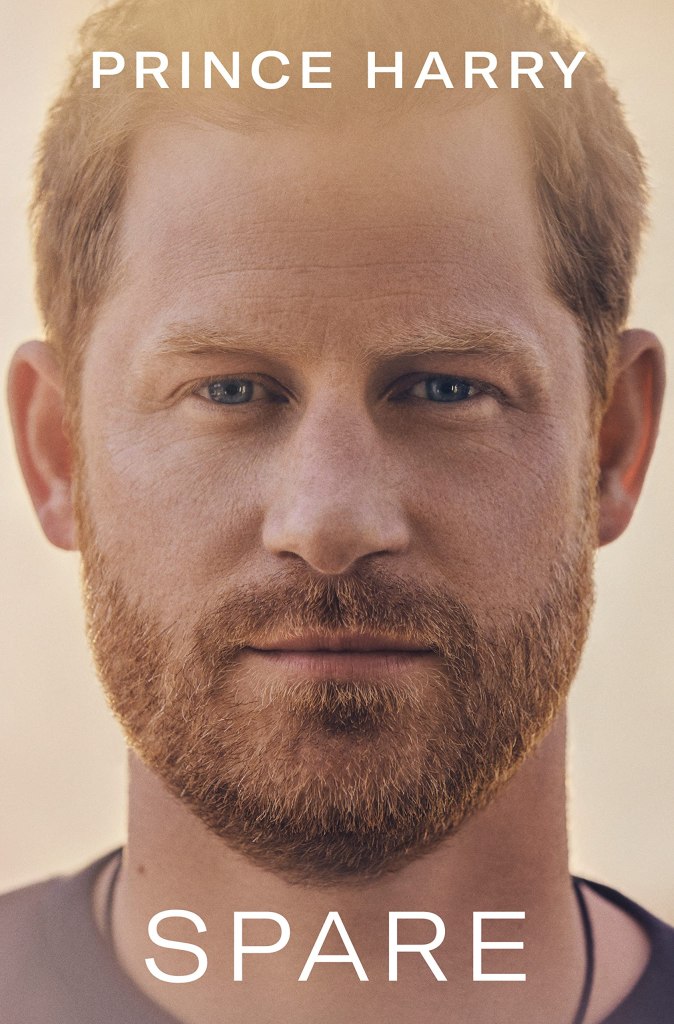
Before reading Spare by Prince Harry, Duke of Sussex, I was aware of people’s complaints about it. It sounds kind of silly, but one complaint was about his retelling of the story where he got frostbite during an expedition to the Arctic. (Actually, it was “frostnip,” which is slightly better than frostbite.) Those readers thought it was too much information since it affected his penis along with his ears and fingers.
Yes, he talked about it in detail. I was almost halfway through the book before I came upon that little anecdote, and I thought it was relevant given the accompanying circumstances.
But I thought, why focus on that? The book is pretty great. The New Yorker described it as compellingly artful, and I agree. Spare is also beautifully written, engaging, informative, and even fascinating at times.
So here I was, giving myself a pat on the back for being a good sport about the TMI instead of nitpicking, and then there was yet another story about that appendage. He calls it his “todger,” by the way. And this time, he described its condition (flaccid) during a harsh training exercise where the soldiers had to strip naked.
At that point, it was like, okay, Harry, enough about your todger.
But I like Prince Harry a lot. I have a great deal of empathy for him and Meghan. I realize that many people will disagree with me, but he broke a toxic cycle and wrote this story bravely.
Sure, many people will say facetiously, “Oh, poor, Prince.” They’ll say he is spoiled. But if you read the book and believe what he says (which I do), you come away with a different perspective.
His story shows that wealth and titles mean nothing if you don’t believe you are loved, welcomed, accepted, valued, and respected in this world. It shows that you can be royalty and lack self-esteem. And that the world may have an image of you that is not who you are. It highlights how people can humiliate you and betray your trust over and over, and how there’s not enough money or esteem in the world to prevent that from happening.
So, I don’t care what the haters say. Prince Harry’s story is heartbreaking.
I fully empathize, regarding how the paparazzi and public badgered him and the women he cared most about in his life, to the point where those women ultimately had to abandon him. The world has failed Princess Di’s sweet boy, and I’m sorry for all the pain he endured. I’m sorry for the pain that Meghan endured.
So, I can forget the parts that made me cringe and attribute that to Prince Harry wanting to be a little self-deprecating. Maybe he doesn’t see any other way to come across as honest and humble, knowing that people will judge him harshly, so he allows himself to be vulnerable. I get it, and it doesn’t lessen his message to us.
What Prince Harry, The Duke of Sussex, has to say is important. That other stuff is trivial by comparison.
I fully support him in exposing unjust systems and institutions.
I applaud him for calling out racism and its tragic impact.
Sharing our stories is vital these days. There’s already too much digging our heads in the sand.
And, so, yes, in terms of a star rating, that’s a five from me.






 D.K. Sanz