WRITING AND LOVING AN INSPIRING MEMOIR

I do love an inspiring memoir, even one that is tragic and sad, as long as there is a flicker of hope! You have to have a curiosity or fascination about people, in general, to want to know about their struggles and achievements. For me, it doesn’t matter if I’m reading it or streaming it; I go all in. Like when I read Carly Simon’s Boys in the Trees, I watched YouTube videos of her and her ex, James Taylor, performing live. About half of one morning, I walked around the house singing their song Mockingbird because it was stuck in my head after replaying the video several times.

What I never expected, however, was to write a memoir of my own. Until recently, it never occurred to me. My goal was to write fiction, and I expressed my views through poetry. Eventually, I realized I had an important story to share, one that could benefit others. Some stories, I believe, can be your gift to leave behind because it’s bigger than you and has the potential to be a lifeline for someone else.

Every single one of us has something to give in that way. I learn from everyone, so I don’t go around with false modesty, thinking no one can learn from me. At the very least, I’ve written something of a cautionary tale.

Just the other day, I noted in a Facebook post that putting ourselves out there, especially in this way, exposes us to criticism no matter what. I wrote, “I’ve read reviews of several memoirs where readers say the author tells the entire story honestly and without complaining, and then other reviewers will say (about the same book) it was nothing but whine, whine, whine. So, I’ve gone through my completed recovery memoir a few times to make sure I don’t sound like a whiny bitch, but I do realize how much perception varies.” 😂

The responses were interesting and encouraging.

A friend said, “I think one of the reasons people read memoirs is to interact with the challenges and important things the author has experienced, things that have caused growth in the author. I think if a reader finds that honesty whiny, then they’re not paying attention, and refusing to get involved, as they read.”

We all, indeed, open these books with a different perspective.

While reading other memoirs, I learned that you have to know your goal in telling the story. To me, it’s obvious when revenge is one of those goals or an urgent need to present one’s side of the story. Some things are written in anger or pain, and I feel fortunate that I’m not in any of those places. I decided that my memoir was about recovery, change, and progression. If I was going to write it, it had to come from a place of love; it had to come from my heart and soul.

I can’t deny that it isn’t a pretty story. It’s tragic and bound to be unsettling, but it’s up to me to find all the beauty in that story because it’s there. It’s not black and white but often overshadowed with grey and interrupted by numerous bursts of color—awe-inspiring, vivid, joyful, and brimming with hope. 

No doubt, I will be judged harshly for what I’ve gotten myself into, but that’s okay. 🙂

Image by Pexels from Pixabay 

Further details about my forthcoming book are provided below.

Book description: 

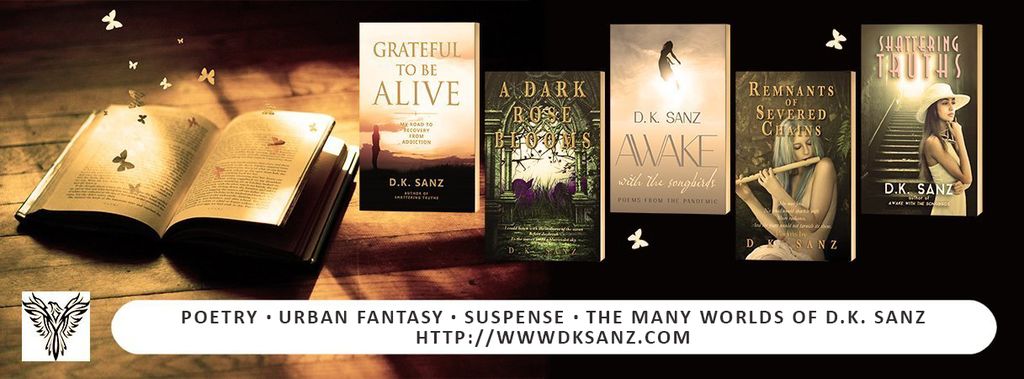
Grateful to Be Alive

My Road to Recovery from Addiction

by D.K. Sanz

Do unsettling truths bring harsh judgment? They do, but the price of denial is steep.

D.K. Sanz’s story begins in the drug-infested New York City streets of Woodside, Queens, during the tumultuous HIV/AIDS pandemic of the 80s and 90s. It offers a glimpse into how a now often-overlooked pandemic impacted Sanz’s nuclear family. 

From her earliest days, D.K. was the easily forgotten stranger, always a little out of sync with the rest of the world—a tough but naïve kid and aspiring writer. Her triumph over illness and addiction includes amusing anecdotes and nostalgic, heartwarming memories.

Grateful to be Alive delves deep into Sanz’s confessional self-sabotage, self-destruction, and the harrowing downward spiral she almost didn’t survive. Her never-before-told story ranges from recklessness and impudence to empathy, forgiveness, and love.

D.K. has since published several books, primarily poetry but also a novel, and she continues to work on sequels and an all-new fantasy series. You’ll find some of her poetry at the end of this book.

Whether struggling or not, you will find Grateful to Be Alive is a story of hope, defying insurmountable odds, finding joy, and a gradual transition toward authenticity and becoming the person D.K. always wanted to be.

ARC Copies

For those unfamiliar, an ARC is an advanced reader copy provided before publication. Each recipient of an ARC intends to read and review the book. Reviews can be anywhere from one sentence to three or four paragraphs. Ideally, they should appear on Amazon and Goodreads the day the book comes out, likely in February. (I will notify you of the release date.) If it’s posted after that date, the sooner, the better, of course, but days or months later is still good. In other words, there is no rush.

Once given an ARC, you are under no obligation to read or review the book, but, at the same time, you wouldn’t want to request an ARC copy if that’s not your initial intention. In other words, if reading the book causes you to change your mind for any reason, there are no consequences, legal or otherwise.

ARCs are free. Currently, I have them available in Word or PDF formats. Eventually, they will be available on Kindle.

Reviews by ARC readers are posted on Amazon and, hopefully, Goodreads if the recipient has a Goodreads account.

ARC readers, unlike beta readers, are not expected to provide feedback to the author besides the public review, but feedback is certainly welcome.

To apply for an ARC, please e-mail me at dksanz@yahoo.com and answer the following questions:

1) Are you familiar with the author’s work? (Just curious, it’s okay if you’re not.)

2) Have you ever reviewed a book by this author?

3) Please briefly explain why this particular book would interest you.

4) Have you reviewed books or products before this request?

5) Do you have an Amazon account?

6) Do you have a Goodreads account?

Unfortunately, I may not be able to accommodate every request, but I thank you in advance for your interest.

Oh, and just for fun, I’ve already created a music playlist for my memoir. You can see it on YouTube for the complete list of 57 songs.

Feature photo at the top (woman sitting on books) by Christine Engelhardt from Pixabay 

GRATEFUL TO BE ALIVE: MY WELCOME

For those interested, I thought I’d share the “introduction” to my forthcoming memoir. All thoughts are welcome!

INTRODUCTION

I never wanted to tell this story—at least not this way. Sure, I was forthcoming in sharing bits and pieces of it with certain groups and individuals, but, for the most part, I aimed to spare my loved ones. Now that I have been given the green light by those who mean the most to me, and after what I’ve witnessed over the past few years, I’m going ahead with my uncensored confessions. Down the rabbit hole we go to unearth the dark tales about lies that save and destroy you, paying the piper when the master is ego, and the challenges accepted at the end of the forbidden road.

It amazes me, still, the shocking things we can survive, especially when we never lose hope or give up on laughter and love. The weight, venom, mire, and bondage of our obsessions create roadblocks and wreak havoc until we take that yellow brick road back to sanity. If you’ve seen the movie, Wizard of Oz, you know what I’m talking about. The wizard at the end of the road is a fraud, but you always had the shoes, right?

Anyway, what matters is what’s real.

My story is about addiction and recovery (from many things). I am one of the fortunate ones who lived to tell how it went for me during my fight for sanity and peace from the late 80s to the mid-2000s. However, even after twenty-seven years of sobriety, when people tell me they have no regrets about their life decisions, I’m sure I misunderstand what they mean by that. Perhaps I’m taking it too literally, but I can’t imagine not having at least some regrets. Most of us have caused pain for others (and ourselves), even if we never meant to, and the one thing I regret more than anything is the people I’ve hurt in my oblivion and ignorance.

In retrospect, it’s hard for me to believe some of the things that happened—that I wasn’t dreaming. A serial killer murdered one of my dear friends. One day, the FBI came to my house looking for a bank robber I knew rather intimately. Except I wasn’t aware that he’d robbed banks; I was only a teenager.

My experiences seem absurd to the kind of people I’ve befriended well after that. They’ve led far more sheltered lives, where their parents took them to museums and ballet performances, and it surprised them that I hung out on street corners with friends and in parks. To quote my now-grown son, “I guess it was a sign of the times. Kids just go wandering around meeting people.”

I couldn’t help laughing when he said it, and I laughed whenever I remembered it throughout the day. Yeah, we weren’t Opie living in Mayberry or Beaver living in Mayfield, but, sadly, there’s danger in doing the most natural thing.

Nevertheless, in telling this story, I will include the humor and joy along with all of the tragic madness.

Yeah, some people will say, “Certain things must be kept private.” Perhaps, but we live in an age of transparency and accessibility. As an introvert, I never liked that, but I get over it when writing. Understanding is critical in the world we live in today.

Some people actually think there’s too much empathy in the world and that we as a species may have to be a little more vicious and cruel to survive, like in the olden days. Maybe even with a bit of medieval torture thrown in for good measure. Those people are wrong, and I’m pleased as punch that both time and history have taught us more about humanity. It’s part of our evolution as a species.

My theory is that malignant narcissism is at the heart of the world’s dysfunction. I’m convinced that we’re dealing with the chaos of the world’s trauma, shame, and pain. It’s the gift that keeps on giving—with the worst possible repercussions, and it spreads through the universe like a poison. I believe this suffering, which leads to more suffering, is a cycle we can break with recognition, empathy, and a genuine desire to change.

While I’m certainly not a professional, I’ve dealt with my share of narcissism throughout my life. Unfortunately, many people have endured far worse than what I’ve experienced, and some have been damaged beyond repair. Whatever we can do to help others toward the light in the darkness can mean the difference between their giving up and holding on.

Most of us already have an underlying fear that people won’t love us for who we are, which, through suffering from narcissistic abuse, gets distorted into the notion that no one will ever love us—period. Underneath it is a chronic sadness that never really subsides, and shame overwhelms us.

Not being loved for who we are is one of the things people fear most in life, a fate worse even than death, and many young people out there are killing themselves for that. They fight to cope with one trauma after another until they reach a breaking point and can’t cope anymore, and then they shut down. The message is I’ve had enough; I can’t do this anymore. I’m out.

Often, when people feel that desperation, getting beyond thoughts of suicide is only the first hurdle. From there, it’s a long haul to reclaim themselves and their capacity to love.

The aim of sharing my story is not to gain sympathy but to shed some light on how certain things develop and how we overcome those challenges even when the odds are against us.

One thing I’ve heard and can relate to as a poet and writer is, “Don’t waste your pain.” Life is beautiful and tragic, happy, sad, and everything in between, and, as a poet, I’m here for all of it. The pain is often long gone by the time we relay things in poetry and books, but we can still empathize with people struggling to navigate whatever we’ve already sorted out.

Speaking of that, I learn from everyone. As I’ve said in another book of mine, a heart that has ached mercilessly can spin a lifetime of agony into a garden of wisdom and solace, offering others comfort and peace. It’s the same heart that knows the ecstasy of being alive and cherishing every moment.

Recovery, for me, has been an ongoing journey toward authenticity, removing the veils layer by layer and discarding the masks. I was told in recovery that we are only as sick as our secrets. Of course, we are allowed to have secrets. But suppose our hidden truth has us living a double life or creating a barrier between us and the world? We tend to compartmentalize aspects of our lives as part of the deception. In that case, it either limits or restricts our healing and impedes our goal of authenticity.

We evolve as we become aware of our patterns and vulnerabilities—and we seek answers. Raw honesty combined with accountability helps everyone, especially those of us who’ve gotten caught in a cycle of self-loathing and self-sabotage. We need truth, spiritual courage, and to remain teachable.

These days, a sacred innocence in me has returned. The ever-present inner child in me is at peace and full of joy. I can see the world’s beauty with the eyes of that child. Even when things get crazy, I sit with this peace. If this peace slips away from me even for a moment, I’ll grasp it again and keep it clutched in my fist.

That’s because our job is to keep resolving things internally so we continue evolving as humans, deepening our understanding, empathy, and compassion. Suffering can be beautiful when we constantly grow, but not if we’re emotionally stuck in the same place without learning from what we’ve endured.

Think of this for a moment: When depicted as fire-breathing monsters, mythical dragons are harmful and dangerous—perhaps diabolical. And, like dragons, some people constantly and painfully attempt to incinerate others with their scathing flames. Even those of us who aren’t so malevolent can wear a dragon’s facade to guard and protect ourselves in the darkest of times, but must relinquish it before it destroys us.

The continuous goal is healing—not simply individual healing but collective healing. We each have our gifts and tools for contributing to the greater good, and it turns out that it’s one massive, collaborative effort, during which time we remain connected as part of a larger entity.

So, I write this book from the heart.

And, by the way, I lived happily ever after. I kicked the ass I had to kick to do it—especially my own.

Well, here we go with the story now. Sit tight. Grab some coffee, tea, or what have you, and all that I ask is, when things get a little too dark and ugly, please try to hang in there with me.

Thanks for reading!

BOOK DESCRIPTION

Grateful to Be Alive

My Road to Recovery from Addiction

Do unsettling truths bring harsh judgment? They do, but the price of denial is steep.

D.K. Sanz’s story begins in the drug-infested New York City streets of Woodside, Queens, during the tumultuous HIV/AIDS pandemic of the 80s and 90s. It offers a glimpse into how a now often-overlooked pandemic impacted Sanz’s nuclear family. 

From her earliest days, D.K. was the easily forgotten stranger, always a little out of sync with the rest of the world—a tough but naive kid and aspiring writer.  Her triumph over illness and addiction includes amusing anecdotes and nostalgic, heartwarming memories.

Grateful to be Alive delves deep into Sanz’s confessional self-sabotage, self-destruction, and the harrowing downward spiral she almost didn’t survive. Her never-before-told story ranges from recklessness and impudence to empathy, forgiveness, and love.

D.K. has since published several books, primarily poetry but also a novel, and she continues to work on sequels and an all-new fantasy series. You’ll find some of her poetry at the end of this book.

Whether struggling or not, you will find Grateful to Be Alive is a story of hope, of defying insurmountable odds, finding joy, and a gradual transition toward authenticity and becoming the person D.K. always wanted to be.

ARC Copies

To apply for an ARC, please e-mail me at dksanz@yahoo.com and answer the following questions:

1) Are you familiar with the author’s work? (Just curious, it’s okay if you’re not.)

2) Have you ever reviewed a book by this author?

3) Please briefly explain why this particular book would interest you.

4) Have you reviewed books or products before this request?

5) Do you have an Amazon account?

6) Do you have a Goodreads account?

For those unfamiliar, an ARC is an advanced reader copy provided before publication. Each recipient of an ARC intends to read and review the book. Reviews can be anywhere from one sentence to three or four paragraphs. Ideally, they should appear on Amazon and Goodreads the day the book comes out, likely in February. (I will notify you of the release date.) If it’s posted after that date, the sooner, the better, of course, but days or months later is still good. In other words, there is no rush.

Once given an ARC, you are under no obligation to read or review the book, but, at the same time, you wouldn’t want to request an ARC copy if that’s not your initial intention. In other words, if reading the book causes you to change your mind for any reason, there are no consequences, legal or otherwise.

ARCs are free. Currently, I have them available in Word or PDF formats. Eventually, they will be available on Kindle.

Reviews by ARC readers are posted on Amazon and, hopefully, Goodreads if the recipient has a Goodreads account.

ARC readers, unlike beta readers, are not expected to provide feedback to the author besides the public review, but feedback is certainly welcome.

Unfortunately, I may not be able to accommodate every request, but I thank you in advance for your interest.

Red shoes image by Victoria_Watercolor from Pixabay 

SHE JUST WANTED TO FEEL SAFE

Another excerpt from my upcoming memoir:

Eventually, I let out a deep sigh and said, “I just want to stay home.”
He grinned. “Not home, Diane, in a cage—maybe one with wires and bars where only you control who enters and who speaks to you or touches you. You want to be protected. Even at home, you want that, and this is not a criticism. It is an observation.”
In retrospect, I’m not sure he understood why I’d developed such an intense obsession with feeling safe. But he did seem to grasp how powerful that need was, while I remained oblivious. I had yet to acknowledge that I consistently rejected reality—preferring fantasy, delusion, and a false sense of calm or any manufactured euphoria which, ironically, wasn’t safe. I also hid from others, not because I didn’t care. I just cared too much, and it hurt.

D.K. Sanz

BOOK DETAILS

Grateful to Be Alive:

My Road to Recovery from Addiction

By D.K. Sanz

Do unsettling truths bring harsh judgment? They do, but the price of denial is steep.

D.K. Sanz’s story begins in the drug-infested New York City streets of Woodside, Queens, during the tumultuous HIV/AIDS pandemic of the 80s and 90s. It offers a glimpse into how a now often-overlooked pandemic impacted Sanz’s nuclear family. 

From her earliest days, Sanz was the easily forgotten stranger, always a little out of sync with the rest of the world—a tough but naive kid and aspiring writer.  Her triumph over illness and addiction includes amusing anecdotes and nostalgic, heartwarming memories.

Grateful to be Alive delves deep into Sanz’s confessional self-sabotage, self-destruction, and the harrowing downward spiral she almost didn’t survive. Her never-before-told story ranges from recklessness and impudence to empathy, forgiveness, and love.

D.K. Sanz has since published several books, primarily poetry but also a novel, and she continues to work on sequels and an all-new fantasy series. You’ll find some of her poetry at the end of this book.

Whether struggling or not, you will find Grateful to Be Alive is a story of hope, of defying insurmountable odds, finding joy, and a gradual transition toward authenticity and becoming the person Sanz always wanted to be.

First ARC copy review:

“When you begin this book, you will not put it down. You will immediately be drawn into Sanz’s bold narrative of a woman, throughout her life, passing through “every forbidden door,” as she says of herself. It is a book of continual growth through experience, defeat, and triumph. The prose is swift, concise, full of irony, truth, and poise. You will not find a more startling, revealing memoir. Highly, highly recommended.” ~ J.T. Masters

ARC COPY INFORMATION

This memoir about recovery from addiction and illness is complete and in the final editing stage.

Before its release in February, I will provide readers with a certain number of ARCs.

For those unfamiliar, an ARC is an advanced reader copy provided before publication. Each recipient of an ARC intends to read and review the book. Once given an ARC, you are under no obligation to do either, but, at the same time, you wouldn’t want to request an ARC copy if that’s not your initial intention. In other words, if reading the book causes you to change your mind for any reason, there are no consequences, legal or otherwise.

ARCs are free. Currently, I have them available in Word or PDF formats. Eventually, they will be available on Kindle.

Reviews by ARC readers are posted on Amazon and, hopefully, Goodreads if the recipient has a Goodreads account.

Reviews can be anywhere from one sentence to three or four paragraphs. Sure, in-depth reviews are preferable, but I will greatly appreciate any effort made. Ideally, they should appear on Amazon and Goodreads the day the book comes out, likely in February. (I will notify you of the release date.) If it’s posted after that date, the sooner, the better, of course, but days or months later is still good. In other words, there is no rush.

ARC readers, unlike beta readers, are not expected to provide feedback to the author besides the public review, but feedback is certainly welcome.

To apply, please e-mail me at dksanz@yahoo.com and answer the following questions:

1) Are you familiar with the author’s work? (Just curious, it’s okay if you’re not.)

2) Have you ever reviewed a book by this author?

3) Please briefly explain why this particular book would interest you

4) Have you reviewed books or products before this request?

5) Do you have an Amazon account?

6) Do you have a Goodreads account?

Unfortunately, I may not be able to accommodate every request, but I thank you in advance for your interest.

Feature image at the top by kalhh from Pixabay 

Second image by Mohamed Hassan from Pixabay 

LOVE AS A WAY OF LIFE

Some people may think unconditional love as a way of life means loving, supporting, befriending, and forgiving everyone in every instance. I see it as a general way to view other humans and a way of having compassion for those who struggle.

It doesn’t mean supporting or necessarily forgiving the behavior of those who intentionally seek to harm others. It doesn’t mean befriending those people.

Unconditional love is a blanket feeling, a way to interact and approach. It’s a way to work at your life’s passions. Overall, it’s a way of being—having an inclusive mindset, offering a welcome space, and relentlessly projecting love. ~D.K.

“People often ask me
what is the most effective technique
for transforming their life.
It is a little embarrassing
that after years and years of research
and experimentation,
I have to say that the best answer is—
just be a little kinder.”
Aldous Huxley

Feature image of heart with dove, earth by Stefan Keller from Pixabay