Creating Authentic Badass Characters in Writing

As a writer, I know all too well how difficult it is to let go of what you want for your story and your characters. Tunnel vision has cost me years in projects that finally made their way to publication. There’s a stubbornness that blinds us, or at the very least, impairs our judgment. We are mama and papa bears with our work. Revelations that we don’t have to do this, or we don’t have to tell it this way may come eventually, but it’s hard to be objective. It’s hard to say to ourselves, “Hello? This isn’t working.”

I have two perspectives—one as a writer and another as an avid reader. But you don’t need both perspectives to notice little things like an author’s tendency to keep reminding you that a character has blue eyes or what not. We get it. But even if we somehow forget, how important is it to remember that insignificant detail? I mean, it’s nice to know, but exerting excessive control leads to overkill.

For instance, we like creating badass characters, right? They certainly keep us entertained. I was discussing this with a friend recently. We had a fun conversation about who is badass on screen and who is not. There was a story we were watching where a supposed badass, one who other characters kept reminding us was a badass, went to great lengths to provoke her nemesis, only to cower when the enemy retaliated. That led my friend to say that a badass isn’t emotional in conflict. While being emotional doesn’t make a character any less tough, they would need to suppress that in key moments of conflict. My friend looks for cool. Some might say only a villain would be cool while torturing or killing someone, but how they appear doesn’t necessarily reflect what’s going on inside of them.

We talked about Game of Thrones where Oberyn Martell earned the nickname “Red Viper” for being such a fierce fighter, and we watched him lose a fight he initially won after much provocation because he wouldn’t shut up. Not badass. He got too cocky. And we were so disappointed.

We agreed that a badass also knows when the fight is over. They don’t keep pummeling someone who can no longer fight back.

Audiences often feel, too, that certain characters do not “earn” their badass moments. An example of that is Rey in Star Wars outshining both Luke and Kylo Ren, the latter of which should also have been a badass and was not, whereas the former actually was. That’s debatable, I’m sure, but it proves my point.

We have different ideas and expectations. Your definition of a badass may not be the same as mine. (It’s a little different writing a memoir, but what is the same is how reliable a narrator you are in your assessments.)

Often, it’s too obvious what we are supposed to see and yet don’t see it, and more as a reader than a writer, I cringe. Sometimes you think you’re getting a badass, but it’s really just a bully with an over-the-top attitude. The character is full of snark and mocking irreverence but hardly worth championing.

I say this as a reader:

  • Don’t call your character a badass or have another character refer to them as a badass either in narration or dialogue.
  •  Especially, do not remind us (in dialogue or narration) that this character is a badass.

When I began writing my first novel, I would decide which of my characters I wanted readers to like, but if I asked them who their favorite was, they often surprised me. I ultimately concluded that I’m going to present my characters. Here they are. Who you want to love or hate is up to you. I have my biases, but you don’t have to feel the way I do about any of them.

To summarize, don’t tell me who is a badass. Don’t tell me who is feisty or fierce or brilliant, etc. Show me! Let your characters be who they are and let the reader decide.

There’s a lot of stuff on the net about what a badass character is, how to create one, etc., and you can take what you like of what you read and present that. Like their skill, their fearlessness, their confidence—those things speak for themselves.

You can also have a character who is not necessarily a badass, but has a badass moment.

It’s not that they always have to be likeable either, so if you want the over-the-top snark, that is fine as long as you don’t care that some readers may like this character and some may not.

TRUE TO THE BOOK CHARACTERS?

Some members of certain fanbases become enraged over the casting of their favorite book characters in adaptations or retellings of the original. Often enough, it doesn’t have to be a favorite character or one they care about. It’s the principal of the thing, they’d say. They don’t welcome change. Disney stories, including Star Wars, seem to be at the top of that list. Seeing fans direct their anger and vitriol at the actors portraying these characters is sad and, frankly, inexcusable.

This topic came to mind because I’m working on a fantasy/horror series—something I’ve always wanted to do. (For whatever reason, I had to get all the other stuff out of the way—the stuff that was haunting me.) I created a slew of characters for the series.

Interestingly, authors now lean toward briefer character descriptions in many genres. Every so often, I’m reading a thriller where the author never describes the characters physically. Me? I like depicting my vision of people and things. However, if I were to have my work chosen for a film adaptation, I’d simply want the first film version’s casting to have the same effect I aimed for with my book characters. For example, I’d prefer the character to be as likable or unlikable as I’d intended, with the right amount of sex appeal and charisma regardless of their hair, eye, skin color, etc. Of course, I’d prefer creative oversight, but that goal would apply either way.

In further retellings, I’d want whoever puts one together to go with a version that feels right for them. I’d say, let your imaginations run wild! The original is always there for anyone who prefers it.

I celebrate diversity. What’s wrong with learning from and about each other? And who can deny that all people, especially children, need positive and accurate portrayals of themselves in books, film, and every other medium? That’s even more critical for underrepresented groups in our society. Inclusion, in a good way, is crucial to one’s self-esteem. 

So, I’m okay with having a brown or black person playing the part of a character described in the book as “having the fairest skin of the land with skin as white as snow.” That was just a physical description. It has nothing to do with the plot. I don’t care if some fable was a Danish tale, and the assumption by a person who isn’t even Danish is that the character should be blah blah blah. We’re talking about fictitious characters here, so I’d need far better reasons to complain. Like an ethnicity, race, gender, or sexual orientation changed or unchanged to provide representation for the underrepresented. And like when it’s essential to the story that a person be this or that.

It’s important to note that sometimes, with casting, you get to see a more appealing, more powerful character than the one from the book. Apparently, when Stephen King saw the film Stand by Me based on his novel, The Body, he was completely blown away. He was speechless, I read, and when he found the words, he said it was the best adaptation of any of his works. I don’t know if his impression included the film’s cast, but I think so because those kids were amazing!

I read, too, that, at first, Anne Rice wasn’t pleased with the casting of Tom Cruise as her beloved Lestat in the film adaptation of Interview with the Vampire. Lestat was her baby and based physically on her husband, who passed away. I can understand that. As a fan, I can say that Tom Cruise was not how I pictured Lestat, but I felt he got the effect she was going for with that character, and he did a good job. Evidently, Anne came to the same conclusion.

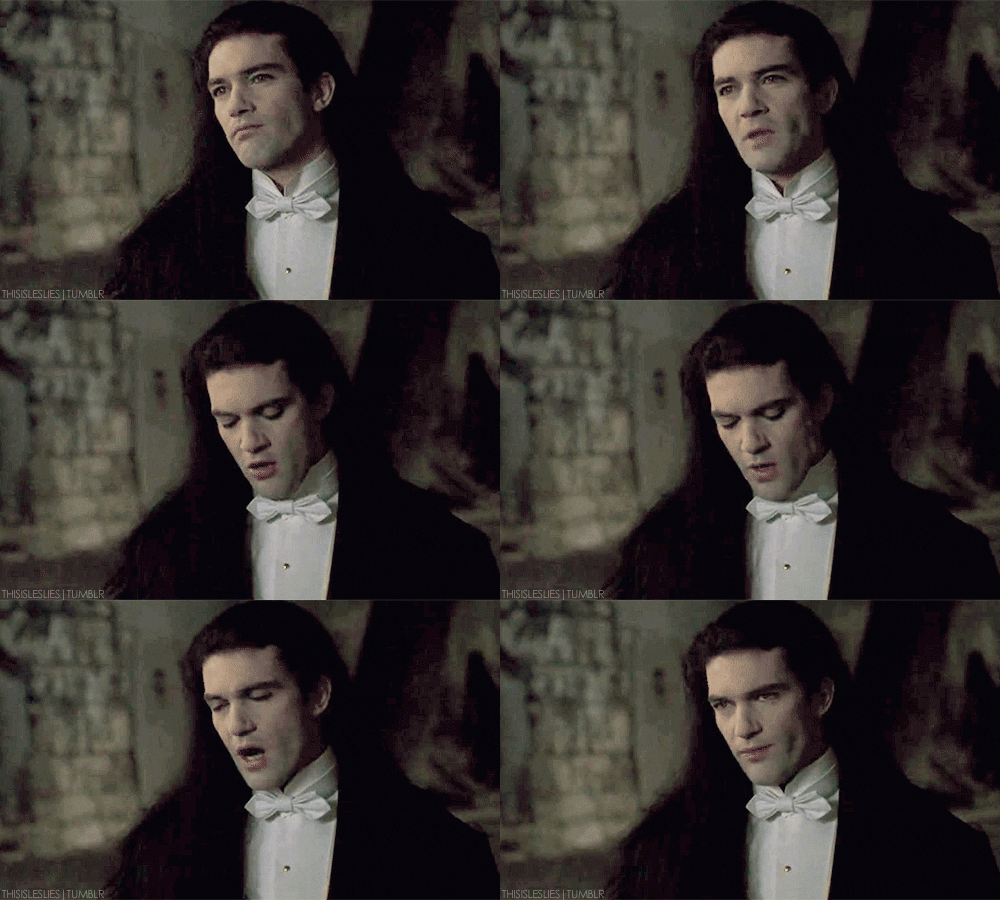
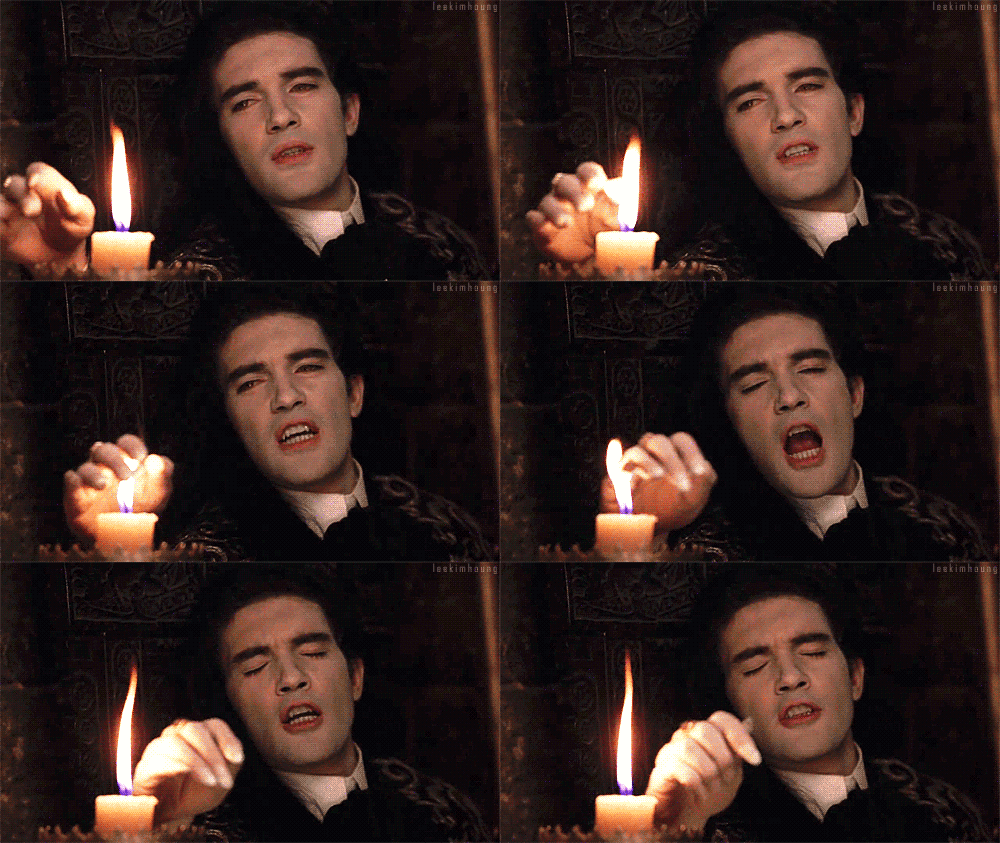
I was never going to be disappointed that the teenage Armand from The Vampire Chronicles got ditched for Antonio Banderas. I’m not sure what Anne Rice thought about that, but I can understand how it was quite a leap for some. In at least one version of Armand’s story, he was distressed that Marius had turned him into a vampire when he was so young. In the Interview with the Vampire, he appeared livid about Claudia being a vampire child for the same reason. So yeah, the casting of Armand in that movie could be a legitimate beef. It was a substantive change. At the same time, Armand was a relatively minor character, and it’s not as if he needed a reason to find turning a child into a vampire unacceptable and appalling. Or maybe that was an excuse because he wanted to get her away from Louis and have Louis all to himself. 🤔

But then, again, Antonio. 🔥🔥🔥

He gave us an excellent and entertaining performance.

The bottom line is that we should have fun with all this stuff and enjoy things as much as possible, and some people could be more lighthearted and open-minded. There’s no reason for anyone to get their knickers in a twist, and certainly no reason to be mean.

That’s just what I think, so what do you think when it comes to the casting of your favorite characters? Were there disappointments? Pleasant surprises? As an author who creates characters, I’d love to know.

Black hair Ariel image by John Huxtable from Pixabay

Top image of male fiction character by u_sqyc105ho4 from Pixabay

Antonio Banderas gif from https://media.giphy.com/media/ZOuFj6MYyPL9e/giphy.gif