SPOTLIGHT ON A BOOK AND AUTHOR

My spotlight in this blog post is on poet/novelist Stephen Alexander North, who writes sci-fi, horror, thrillers, fantasy, and poetry, and his newest release, Dead Tide. This is the first book in the Dead Tide series. 

THE WORLD IS ENDING, BUT THERE ARE SURVIVORS!

Nick Talaski is a hard-bitten angry cop. Graham is a newly divorced cab driver. Bronte is a Gulf War veteran hunting his brother’s killer. Janicea is a woman consumed by unflinching hate. Trish is a gentlemen’s club dancer. Morgan is a morgue janitor.

THERE ARE NO CONTINGENCY PLANS FOR THIS!

The dead have risen, and the citizens of St. Petersburg and Pinellas Park are trapped. The survivors are scattered, and options are few. And not all monsters are created with a bite.

Some still have a mind of their own

Blake

The smell of death and decay would always be with him. No amount of scrubbing or sterilizing dulled it. However, he was so familiar with it he barely perceived it, and now he only noticed the smell when he opened a door. He pushed his mop and bucket along a gleaming white-tiled corridor, trying to ignore the squealing of the wheels.

There was a double door just ahead. A sign to the left of the doors read: Decedent Storage and Investigations. He held one door open with his body and pulled the bucket through. His boss, one of the technicians, stood just a few feet away inside.

“Ah, there you are, Blank. Table six has a spill… bastard had a colostomy bag, and I didn’t know it. The thing burst all over. Hop to it! Dr. Bastrov will be in soon.”

“It’s Blake,” he corrected, hoping none of his irritation showed, keeping his eyes cast downward. He was a small man after all, and his boss a hulking behemoth, grossly fat—probably three or four hundred pounds—but still strong. Blake knew he would only be in trouble if his boss could catch him.

The man grinned broadly and smacked his own forehead in mock reproof. “That’s right, how could I forget, Blank—-Blake?” The grin faded. “Better get your ass in there and clean up, or…”

Blake saw a slick of blood, feces, and probably urine forming a coagulating stain around a gleaming autopsy table. The corpse was still there, but none of the coroner’s staff was present, just his boss and buddy, good ‘ole Joss “The Hoss” Hawkins. He resumed pushing his bucket toward the table.

He’s not my buddy. The bastard hates me.

“I’m going for a cigarette, boy, so when you’re finished here I want you to start on the men’s room on the first floor. Got me?”

The urge to snap a salute was strong, but he forced it down. “Sure thing, boss,” he said and dipped the mop into the hot soapy water. Hawkins brushed past him and through the door. Blake couldn’t help but stand there by the puddle for a moment, trying to collect himself. He pushed the mop into the putrid mess, smearing it over the tiled floor.

There was a violent thud, and he whirled, thinking Hawkins was up to something.

No one was there. He looked at the three tiered rows of storage drawers for decedents, each one a polished metal sliding tray and most of them containing a piece of dead meat. He was certain he had heard a noise, though, and wondered if Hawkins was playing a joke on him.

Three or four additional thuds came from several drawers. The pounding came quicker, and then there was a metallic clatter from behind him. He spun back around, tensing; the mop held before him defensively.

He let out a long, drawn-out sigh. “Good Lord, you gave me a fright, Doctor.”

The doctor looked at him, and Blake realized he’d never seen this sort of expression on her face before: a mix of fear and puzzlement. One elegant eyebrow arched as she tilted her head toward the noise. Even now, he found himself captivated by her. Her long, lustrous chestnut hair was up in a ponytail, but the bangs had come free and framed the pale oval of her face.

“What’s going on?” she asked. When Blake shrugged, she said, “Call Tech Hawkins right now. This better not be some kind of joke.”

“Right away, ma’am,” he replied. “I’ll page him.”

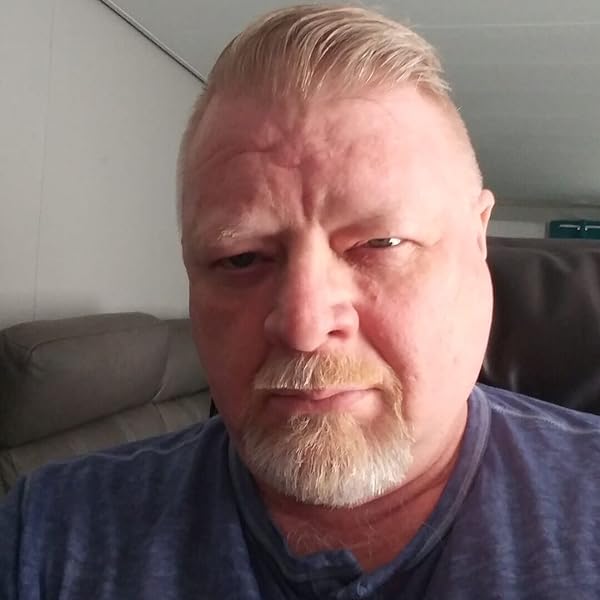
Stephen Alexander North is a Florida native, a closet lounge singer, and the Obscure Floridian Writer of sci-fi, horror, thrillers, fantasy and poetry. He has a Bachelor of Arts in English Literature from the University of South Florida. He served in the Army Reserve as a military policeman from 12/84 to 12/90 (reaching the rank of sergeant). At fifteen, his first job was taking care of over 200 parakeets, and 100 lovebirds in a neighbor’s garage. At sixteen, his first ‘real’ job was making camera bellows (the black accordion part on old style cameras) Some of the bellows were for NASA—Probably not any made by him though. From there, he worked in the fast-food industry (a grill god at McDonald’s), a bookstore (or Heaven, as described by the author), then three major retailers (Maas Brothers, Home Depot, then Walmart). He’s also worked, briefly, in a print shop (that ended abruptly when he nearly fell into one of the presses, which might, at the very least, have cost him an arm).

His favorite hobbies are listening to music, reading books, walking the dogs, Sancho and Oreo, and riding his bike with Kerri (his girlfriend).

He has a daughter that he’s very proud of.

You have a lot of titles out there, some poetry books and some horror genre fiction. You like to write about zombies. What has drawn you to that genre?

I will say seeing the original Dawn of the Dead movie when I was sixteen or seventeen really grabbed me in a how would I survive type sense. It wasn’t just that though, especially as time went on, and I worked in retail. There’s social commentary going on here, and the topic of consumerism and people going to the mall… Anyway, I found out, somewhere around 2005 or 2006, that a publisher was looking for these types of novels. I’d written and self-published my first book (an alien invasion/sci-fi thriller) at that point, and writing a zompocalypse novel seemed like a great challenge. Could I do it? And at that point, I’d been in retail over twenty years—I’d had plenty of experience with people from all walks of life. What if I wrote an epic zombie survival novel with a huge cast of characters! I went for it, although I had no idea how dark this book would get.

Tell us about your latest release.

I had two books release on the same day! One of them was my fifth poetry book, A View From The Edge, and the other was the re-release of my first zombie novel entitled Dead Tide. It has been with two different publishers, and this is actually the fourth edition! Currently there are four books in the series, and a possible fifth is under consideration/contemplation. The series is about a group of people, actually more than one group, trying to survive in St. Petersburg, Florida. It’s written from a moment to moment perspective, with alternating viewpoint characters by chapter. 

What is the hardest part of writing these books?

I had no idea how dark they would get. Never know what’s around a corner.

Give us an insight into one of your main characters.

There’s a police officer named James Dodd. You might not get the idea that’s something’s off about him right away, but other police officers play pranks on him, and you do find out later that he lives with his mother, but doesn’t go to check up on her when everything goes to pieces.

Is anything in your fiction books based on real life experiences or purely all imagination?

The real world, and my life experiences make it into my books, along with imagination. The question might become, where is the dividing point. Many of my stories are set in my hometown of St. Petersburg, or nearby: Pinellas Park, Tampa, or somewhere else in Florida.

What have you learned from writing your books?

Writing and reading are escape portals to somewhere else. You don’t really need to go anywhere to have the adventure of a lifetime.

Is there a message in them you want readers to grasp?

While I do address certain issues or mindsets in my stories on occasion, the primary intent is escapism or entertainment. Here’s someone in a moment so you can put aside whatever you’re struggling with in real life for now.

When did you first consider yourself a writer, or do you recall how your interest in writing originated?

Going through the wardrobe to Narnia, and finding the ring with Bilbo were probably the true catalysts! Although my first short story had its roots in the tales of Horatio Hornblower, an English sea captain in the late 1700s. It’s funny, but many things I’ve written were for a purpose, not just something I’ve dreamed about per se. I was in sixth grade (reading the Hornblower series), when my Spanish teacher asked us to write a story for class. Senor Bailes was his name (a wonderful, amazing guy). So, I wrote a story of an English sea captain trying to capture the Manila Galleon (a Spanish treasure ship). I haven’t written any stories since then in that vein, but there is one poem!

What techniques and tools do you use to keep yourself organized?

I save my works-in-progress (with a date attached) often. My work desk is usually a wreck strewn with papers, pens, headphones, books and notebooks. I think I just listed a lot of things I don’t do to be organized. lol    

What is the easiest thing about writing?

Using a computer! I started off with pencil (preferably pen) and paper, then a typewriter, word processor and finally a computer. Seeing your story on paper or on a computer screen really gives this it feels like a book vibe for me. Other than that, actually coming up with an idea of what to write about is easy most of the time.

How long on average does it take you to write a book?

When I was working full-time, usually a year. Since I’ve retired it’s different, but not what I expected necessarily. I haven’t adjusted to retirement, and I’m still focused on re-acquiring my health. Aside from that, I think I wrote three poetry books last year. It’s been a long time since I actually finished writing a novel. Short stories usually a week or two, although I haven’t written many of those lately either. There’s one in an upcoming anthology (hopefully this year)!

Are there any occupational hazards to being a novelist?

Haha, I remember getting hit on by swingers at a convention in Pittsburgh (a book signing convention)! On a more serious note, yes there are. There are judgmental people out there who will decry your work without reading it. Many of them are fearful of what they don’t understand. Family members aren’t always supportive or understanding. This can be a spouse who wants you to watch tv, or ‘someone’ who thinks you’re a weirdo for writing about zombies. This can be people who won’t come to what is probably one of the biggest moments in your life (a book signing at a bookstore or landmark in your hometown). I guess the bottom line is people who don’t get your passion. This could apply to anything really, not just being a novelist. So, I get it. That’s where the friends, family and fans who do appreciate what you’re doing, really make a difference.

Writing about sex – easy or difficult?

Depends on the context? In one of my short stories, and several of my poems, I had anxiety about it. The short story was easier to ‘let go’ in that people know (I think) that it’s just a story—a seedy, gritty story, but just that. Somehow the poems were more intense in that it feels personal, whether it is or not. It’s better to let go. People will like you or like your books, or they won’t. I will say that one poem that gave me the greatest anxiety was one that people mentioned to me as being a favorite. That was cool. Writing under a pen name saves some of that grief.

What has been the toughest criticism given to you as an author?

Too many characters. Chapters are too short. This is a dance of hopelessness. Those three comments were originally complaints on Dead Tide, but many people liked the work for the same reasons. More to the point, criticism from fellow writers and editors, was the toughest, but most helpful. I’ll take tough, constructive criticism any day and consider it, but “I’m giving this book one star because it’s too expensive!” is completely unfair. I’ve had that comment a few times on books of mine sold by a publisher. 

What has been the best compliment?

The love and support for my books from my friends, family and fans.

Was there a person in your career who has impacted you the most or who has really made a difference? 

The sci-fi author Keith Laumer once spent a couple hours on the phone talking with me, about books, my writing, and invited me to visit him, but more so is my girlfriend, Kerri. She’s made a huge difference in my life, and has been a tremendous help with my books.

Which writers inspire you or are your favorites, and what really strikes you about their work?

There are so many! The first two that come to mind are Keith Laumer and Robert B. Parker. They both frequently wrote from a first-person perspective, and I greatly admired their writing styles. Both injected humor, but in grim settings or situations. There was often a noirish feel to their works. Most of Laumer’s works were sci-fi, and Parker’s were detective-type mystery/thrillers or westerns. Something about their narrative voices really spoke to me.

What are the most important attributes to remaining sane as a writer?

I chuckled reading that question. Not that it isn’t a good one, but I may not be sane. My answer, though, is manage your expectations. I have known people that have great success with their writing. Six figure success. Most of us are nowhere close to that. Taking a walk, or going on a bike ride helps too.

Do you admire your own writing?

Yes! I’ve come a long way. Sometimes I’m shocked by what I’ve written. It’s a good feeling.

Have you ever hated something you wrote? 

When I first started out, I’d always end up hating it. With time, and critiques, I moved past that. 

Who would play you in a film of your life?

Rutger Hauer? Lol John Candy more likely! I haven’t always been heavy, but I am a big guy. Despite the sorrow, there’s been a lot of laughs too. I try not to take things too seriously, but sometimes I do.

What are your thoughts on good/bad reviews?

As long as it’s fair, I think I handle them well. Fair or not, it’s part of putting my work out there for sale. As to ones I’ve written, I’ve never given less than three stars. If it deserves less than that, I didn’t write one. Just me. I have told people in private or in a group what I thought was wrong, or what I didn’t like. 

Which social network works best for you?

Currently, I’m present on more than I ever have been before. Facebook is best for me so far as far as interest in my books. I’ve been tweeting for each book release, and I’m on Instagram and Threads, but on the latter two, I haven’t really experimented much. I’m not on TikTok. I do have my own channel on YouTube with fourteen subscribers and around a hundred views. I plan to record myself reading poems more often (but probably not anymore where I’m singing).

Any tips on what to do and what not to do?

I think writing for anthologies is a good idea. Give it a shot anyway. Most of them for me have been for charity. That is wonderful in itself, but when you write for an anthology, there’s usually a theme they’re looking for. This can lead you to writing something you never would have! Plus, it’s a publishing credit! I was in one charity book that included one of my favorite authors! I was in an unpaid anthology that had an introduction by another of my heroes. And I’ve been in a bunch that included friends. That matters to me. I write what makes me happy, and what challenges me. I’ve really enjoyed going to book conventions too. If you go to one as an author, sign up for the interview panels, do the book readings!

How do you relax?

I listen to music, or take walks in a park. Either of these things often lead to writing. I love to read. I haven’t done yoga in a long time, but enjoyed that too.

Who are your heroes?

My parents, David and Joyce, my brother, Ron, a teacher, Bill White, another teacher, Mike Prosynchek, two drill sergeants, SSgt Hope and SSgt Goss, a squad leader, Kurt Kobel, my best friend, David Wawrzynski, another teacher, Jane Buck Addis, a friend, Tina Kurcz, and my girlfriend, Kerri Gregory.  

What is your greatest fear?

Heights.

Your proudest achievement?

Being a father

If your friends or family members were asked to pick three character traits that describe you, what would they say?

Honest, integrity, noble

What are three positive character traits you don’t have?

Not sure how to answer that one.  

If you could be anywhere in the world right now, where would you be? 

Right here at home.

What is your favorite book and why?

I loved Tolkien’s The Silmarillion. It was a world I would love to live in and explore.

What’s the best movie you’ve seen in the last year?

Death on the Nile was decent. I’ve missed a lot of movies lately.

What would you do if you won the lottery? 

Buy an SUV, a better house with a huge library (and all the books still on my TBR list), enjoy some traveling, get a personal trainer to help me get into better shape sooner, and help out some people that I care about. I’m sure I’m forgetting major things. 

What is your favorite memory from childhood? 

All the special times my family had together. It’s hard to pick one.

What is your favorite motivational phrase?

I’m beautiful inside and out.

What advice would you give to your younger self?

I’d be more apt to say something to someone I love to save their life. If I convinced my younger self to change a behavior, I wouldn’t be me now.

Do you laugh at your own jokes?

I’m often self-amused.

What makes you cry?

Onions and pictures.

What makes you laugh?

Many things, my friend.

What’s the loveliest thing you have ever seen?

My daughter’s entrance into the world.

What advice would you give to aspiring writers?

Join a writer’s group to get used to criticism. Read Damon Knight’s Creating Short Fiction. Read! Challenge yourself with different types of writing, or genres, or points of view.

https://payhip.com/StephenAlexanderNorth

https://www.youtube.com/channel/UCtKvNLqgTkt3eCDTjvPdweQ

https://books2read.com/ap/8Ywqya/Stephen-Alexander-North?fbclid=IwAR3pHqlGukzVEmS-uJ8KhVkazQ6fw23QoFnVwpbSk01A9F3OvTGnXIbYxAI

I BELIEVED THAT HE LOVED ME

However, all the while, l clung to the belief that he loved me. He was a brave, modest man, generous with his assistance and advice—there as a rock, always. As a child, I worried obsessively about him when it was near time for him to come home from work—that something would happen to him, and he might not make it home to us. I guess you can say my love for him was as out of proportion as my fear of him.

Grateful to Be Alive: My Road to Recovery from Addiction by [D.K. Sanz]

Enter my New Summer Giveaway!

1st prize  – Kindle Paperwhite – waterproof, 8 GB storage

2nd prize -16 quart insulated portable cooler with heavy duty handle

3rd prize – 100% Turkish cotton sand-free beach towel (blue and red stripes) 71″L x 38″W

4th prize – Waterproof phone cases – superior waterproof protection

5th prize –  Colorful beach chair towel clips

Click on Book Blitz photo to enter!

Feature image of father and child walking and image of father with baby by StockSnap from Pixabay 

WELCOME TO MY TOTALLY ABSURD DREAMS

It was a recurring dream for many years.

I’m in the bleak underground, waiting for a train. There’s just enough light from the incandescent lamps to cast a dingy yellow glow. Trains pass, but they look ancient. Still, they are un-defaced by familiar graffiti. Near the passenger doors, the stops each train would make are listed on a flipping board. I don’t recognize any of these places.

Rooted to the platform, I ask strangers for directions. None of them have ever heard of this place I want to go to—never heard of Woodside, Queens.  Lost and disoriented, I feel deep distress and despair.

In my mind, I recall Manhattan’s glittering skyscrapers seen at a distance, beyond the river and the bridge. I remember my train rumbling speedily toward the heart of Queens, passing through the tunnel into sunlight. Sometimes, I’d catch the sunsets when my train emerged from the tunnels, and I was in awe of the dark navy sky and its sweeping reign over the houses with their golden-lit windows. Or the trail of light orange and the vibrant, darker orange that faded into a pale gray sky.

The strangers around me finally mention places that sound somewhere near where I want to go—still far, but I have some hope I’ll get closer. I’ll get there eventually. And I’m willing to settle for that.

Oddly, we’re outside now, still on the platform, but it’s more colorful here. I see trees and recognize the stranger beside me, but he’s barely an acquaintance. The train chugs along, but it’s too crowded when it arrives. I can’t get in, but he does. There’s simply no room for me. I don’t fit.

Suddenly, another train barrels toward me, its rapid arrival quite unexpected. I hear the beeps and clangs, and I think, “That’s the one.”

Without hesitation, I scramble on board. I never check where it’s headed. We travel farther and farther away from all that’s familiar. Soon, I am far from the place I call home and everything and everyone I had ever known. We pass an endless green sea with a boat in the distance. We are somewhere remote. I don’t recognize this place.

My dreams are vivid, yes, and colorful, and my recollection of them is thorough.

In another persistent dream I’ve had since my recovery, and until recently, I ride a motorcycle that I’m so proud to be riding. (I’ve only ever ridden on the back of one.) As the dream progresses, the motorcycle becomes a bicycle, which I did ride as a kid, and, in the dream, I’m still thrilled because I’m cruising everywhere, including up and down the dark streets of Woodside, my old stomping ground.

I’m experiencing freedom in this dream, and I’m celebrating it, so I’m happy. Except that the bike gets smaller and smaller until I’m on a tricycle that I’ve obviously outgrown.

There’s also a recurrent nightmare where I have to get home from Roosevelt Avenue—that walk home at night from the park I’d dreaded as a kid, as well as the route home after work from the train station when I lived in Woodside. It’s light at first in the dream but gets darker and darker until it’s completely dark. I’m never a kid in the dream, but, still, the dilemma frustrates me and plays out as an obsession. Whatever way I choose to go, that long, seemingly deserted hill can’t be avoided, which in reality is true unless I take the route from the crowded, brightly lit storefront area on 61st Street. Even then, I’d have to go past the place on Woodside Avenue where it’s eerily quiet at night.

More recently, I dreamt that I was stranded somewhere and ran into my parents. I asked for a ride home, and they refused for some reason that made no sense. At first, I thought, well, it’s beginning to snow now and starting to get dark, but I’ll make it. As I walked, it continued to grow darker. The snowfall became heavier, so I tried running. Creepy people tried to lure me into alleys. Somehow, though, I got past those creatures and arrived home.

My son was asleep in his room. I must’ve gone to sleep, too. In that same dream, I awoke in the dark to find the door locks broken off the door. A sign was on the front door saying, I hate you. I will destroy you. It was written in blood. People with cold, angry eyes and a few angels floated around the room. They did nothing to physically harm me, but they were holding my son captive, so I charged in there like a martial arts movie hero, kicking them all. They had an invisible shield I couldn’t penetrate, so I went to the door, opened it, and began screaming and begging for help. No one answered.

Now, I can easily interpret what that awful nightmare meant, but David said, “You should never go to sleep. Your dreams are horrifying.”

That had me splitting my sides, and he was equally amused.

Transportation is a common theme in these dreams, and I am moving by bike, train, or on foot. I think, symbolically, it has to do with where I’m going—my path or journey, my goal, and whatever happens in getting there. There’s the persistent question of whether I’m heading in the right direction, and, according to a book I’d read a about dreams, train stations represent transformation. I don’t think any of these dreams suggest I am lost, but I am consistently unable to go home, and I don’t fit or belong there.

The destination is always Woodside, although I haven’t lived there in decades and will never have to make that walk again from any street. Woodside, with its good, its bad, its horror, and its beauty, will always be special to me, and I get those bittersweet pangs of nostalgia when anyone so much as mentions my hometown of Queens. However, my fear at the time I lived there was possibly intense enough to carve out a permanent space in my subconscious mind. Or, it merely represents a place of origin because I’ve wondered if, in order to persist with your ultimate goals, you can’t go back.

The “threats” in my dreams are all of the obstacles.

Interestingly, I was about to say I hadn’t had a “train” dream in a while, but one occurred the other night. In this one, all the subway stops had their names changed. Some were crazy names like Anywhere You Want to Go, while others simply said 50th Road or some other ordinary thing. Per the usual, I had no idea where any of those stops would leave me on the way to Woodside. The platform on this station was perilously narrow, so I had to be careful, even sidestepping rocks while navigating what little room I had.

On a lighter note, I once dreamt I was a cookie, and mobs of people chased me, wanting to eat me. Amused, I told David that I’d had that dream.

“Of course, you did,” he replied, and we shared a good laugh.

Excerpt on ‘Dreams’ from Grateful to be Alive – My Road to Recovery from Addiction by D.K. Sanz

Woman sleeping/night moon feature photo by IceRedfield from Pixabay 

Train image by annca from Pixabay 

Monster in window image by 1tamara2 from Pixabay 

Train station image by Igor Ovsyannykov from Pixabay 

Gingerbread man image by artistlike from Pixabay 

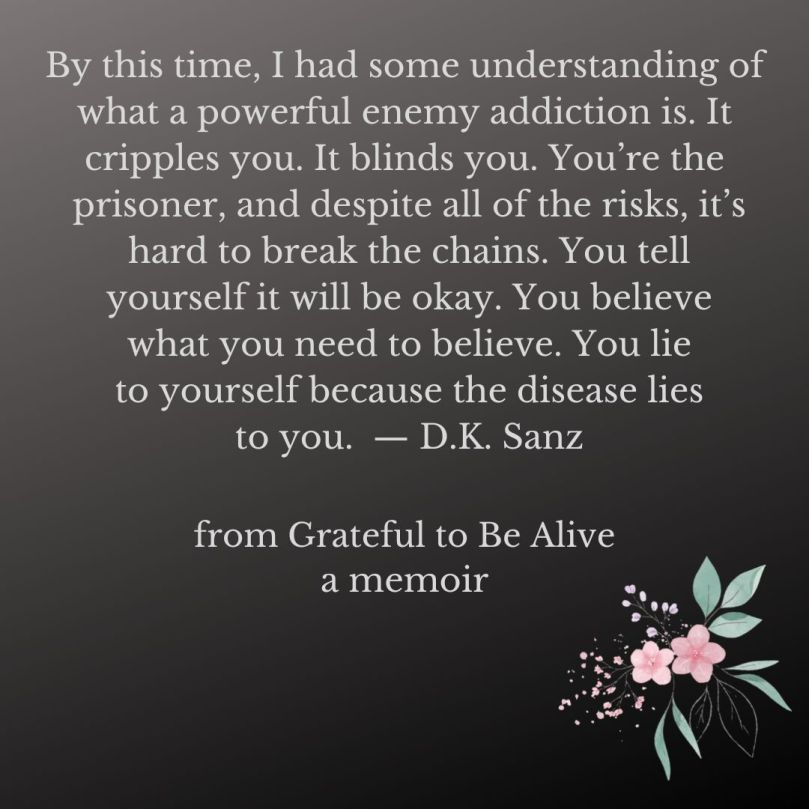
YOU BELIEVE WHAT YOU NEED TO

AVAILABLE ON KINDLE NOW:

Do unsettling truths bring harsh judgment? They do, but the price of denial is steep.

D.K. Sanz’s story begins in the drug-infested New York City streets of Woodside, Queens, during the tumultuous HIV/AIDS pandemic of the Eighties and Nineties. It offers a glimpse into how a now often-overlooked pandemic impacted Sanz’s nuclear family. 

From her earliest days, Sanz was the easily forgotten stranger, always a little out of sync with the rest of the world—a tough but naive kid and aspiring writer.  Her triumph over illness and addiction includes amusing anecdotes and nostalgic, heartwarming memories.

Deep-dive into Sanz’s confessional self-sabotage, self-destruction, and the harrowing downward spiral she almost didn’t survive. Her never-before-told story ranges from recklessness and impudence to empathy, forgiveness, and love.

Sanz has since published several books under the name Kyrian Lyndon, primarily poetry but also a novel, and she continues to work on sequels and an all-new fantasy series. You’ll find some of her poetry at the end of this book.

Whether struggling or not, you will find Grateful to be Alive is a story of hope, defying insurmountable odds, finding joy, and a gradual transition toward authenticity and becoming the person Sanz always wanted to be.

“Addiction, at its worst, is akin to having Stockholm Syndrome. You’re like a hostage who has developed an irrational affection for your captor. They can abuse you, torture you, even threaten to kill you, and you’ll remain inexplicably and disturbingly loyal.”  -Anne Clendening

Addiction is the only prison where the locks are on the inside. — Unknown

Feature image at the top by Khusen Rustamov from Pixabay 

HE SHOT MY SWEET, LOVELY FRIEND

COMING SOON!

EXCERPT:

“Kristina went dancing at a club in the Bronx with a friend. Upon their return, they talked in the car for a while. Of course, it was pitch-dark by then and eerily quiet when, quite suddenly, a man crept out of the shadows, aiming a .44 revolver at point-blank range. He didn’t know them, but they were his target.
One of several shots he fired hit Kristina in the head. In an instant, she slumped over and collapsed onto the pavement. She had no time to scream, and I doubt she ever noticed him. But, just like that, she was dead.
 A friend called me at work to break the news. Before I could put the phone down, all eyes were on me—the eyes of shocked and curious coworkers gauging my reaction. Speculation ensued within earshot.
‘Maybe it was a mob hit. Her family’s Italian.’
‘What was she doing out at two o’clock in the morning?’
It infuriated me that Kristina’s integrity was in question because she was the victim. I was stunned into silence. I had chills. But despite the crushing pain, I didn’t cry until later, when the distress made me wonder again about the divine protection we so naïvely expected. Why Kristina? I had to ask. Why anyone? But why Kristina?”

Grateful to Be Alive

My Road to Recovery from Addiction

by D.K. Sanz

Do unsettling truths bring harsh judgment? They do, but the price of denial is steep.

D.K. Sanz’s story begins in the drug-infested New York City streets of Woodside, Queens, during the tumultuous HIV/AIDS pandemic of the 80s and 90s. It offers a glimpse into how a now often-overlooked pandemic impacted Sanz’s nuclear family. 

From her earliest days, D.K. was the easily forgotten stranger, always a little out of sync with the rest of the world—a tough but naïve kid and aspiring writer. Her triumph over illness and addiction includes amusing anecdotes and nostalgic, heartwarming memories.

Grateful to be Alive delves deep into Sanz’s confessional self-sabotage, self-destruction, and the harrowing downward spiral she almost didn’t survive. Her never-before-told story ranges from recklessness and impudence to empathy, forgiveness, and love.

D.K. has since published several books, primarily poetry but also a novel, and she continues to work on sequels and an all-new fantasy series. You’ll find some of her poetry at the end of this book.

Whether struggling or not, you will find Grateful to Be Alive is a story of hope, defying insurmountable odds, finding joy, and a gradual transition toward authenticity and becoming the person D.K. always wanted to be.

“When you begin this book, you will not put it down. You will immediately be drawn into Sanz’s bold narrative of a woman, throughout her life, passing through “every forbidden door,” as she says of herself. It is a book of continual growth through experience, defeat, and triumph. The prose is swift, concise, full of irony, truth, and poise. You will not find a more startling, revealing memoir. Highly, highly recommended.” ~ Jason T. Masters

If you are interested in obtaining an ARC copy, please e-mail me at dksanz@yahoo.com.

Feature image by Mystic Art Design from Pixabay 

GRATEFUL TO BE ALIVE: MY WELCOME

For those interested, I thought I’d share the “introduction” to my forthcoming memoir. All thoughts are welcome!

INTRODUCTION

I never wanted to tell this story—at least not this way. Sure, I was forthcoming in sharing bits and pieces of it with certain groups and individuals, but, for the most part, I aimed to spare my loved ones. Now that I have been given the green light by those who mean the most to me, and after what I’ve witnessed over the past few years, I’m going ahead with my uncensored confessions. Down the rabbit hole we go to unearth the dark tales about lies that save and destroy you, paying the piper when the master is ego, and the challenges accepted at the end of the forbidden road.

It amazes me, still, the shocking things we can survive, especially when we never lose hope or give up on laughter and love. The weight, venom, mire, and bondage of our obsessions create roadblocks and wreak havoc until we take that yellow brick road back to sanity. If you’ve seen the movie, Wizard of Oz, you know what I’m talking about. The wizard at the end of the road is a fraud, but you always had the shoes, right?

Anyway, what matters is what’s real.

My story is about addiction and recovery (from many things). I am one of the fortunate ones who lived to tell how it went for me during my fight for sanity and peace from the late 80s to the mid-2000s. However, even after twenty-seven years of sobriety, when people tell me they have no regrets about their life decisions, I’m sure I misunderstand what they mean by that. Perhaps I’m taking it too literally, but I can’t imagine not having at least some regrets. Most of us have caused pain for others (and ourselves), even if we never meant to, and the one thing I regret more than anything is the people I’ve hurt in my oblivion and ignorance.

In retrospect, it’s hard for me to believe some of the things that happened—that I wasn’t dreaming. A serial killer murdered one of my dear friends. One day, the FBI came to my house looking for a bank robber I knew rather intimately. Except I wasn’t aware that he’d robbed banks; I was only a teenager.

My experiences seem absurd to the kind of people I’ve befriended well after that. They’ve led far more sheltered lives, where their parents took them to museums and ballet performances, and it surprised them that I hung out on street corners with friends and in parks. To quote my now-grown son, “I guess it was a sign of the times. Kids just go wandering around meeting people.”

I couldn’t help laughing when he said it, and I laughed whenever I remembered it throughout the day. Yeah, we weren’t Opie living in Mayberry or Beaver living in Mayfield, but, sadly, there’s danger in doing the most natural thing.

Nevertheless, in telling this story, I will include the humor and joy along with all of the tragic madness.

Yeah, some people will say, “Certain things must be kept private.” Perhaps, but we live in an age of transparency and accessibility. As an introvert, I never liked that, but I get over it when writing. Understanding is critical in the world we live in today.

Some people actually think there’s too much empathy in the world and that we as a species may have to be a little more vicious and cruel to survive, like in the olden days. Maybe even with a bit of medieval torture thrown in for good measure. Those people are wrong, and I’m pleased as punch that both time and history have taught us more about humanity. It’s part of our evolution as a species.

My theory is that malignant narcissism is at the heart of the world’s dysfunction. I’m convinced that we’re dealing with the chaos of the world’s trauma, shame, and pain. It’s the gift that keeps on giving—with the worst possible repercussions, and it spreads through the universe like a poison. I believe this suffering, which leads to more suffering, is a cycle we can break with recognition, empathy, and a genuine desire to change.

While I’m certainly not a professional, I’ve dealt with my share of narcissism throughout my life. Unfortunately, many people have endured far worse than what I’ve experienced, and some have been damaged beyond repair. Whatever we can do to help others toward the light in the darkness can mean the difference between their giving up and holding on.

Most of us already have an underlying fear that people won’t love us for who we are, which, through suffering from narcissistic abuse, gets distorted into the notion that no one will ever love us—period. Underneath it is a chronic sadness that never really subsides, and shame overwhelms us.

Not being loved for who we are is one of the things people fear most in life, a fate worse even than death, and many young people out there are killing themselves for that. They fight to cope with one trauma after another until they reach a breaking point and can’t cope anymore, and then they shut down. The message is I’ve had enough; I can’t do this anymore. I’m out.

Often, when people feel that desperation, getting beyond thoughts of suicide is only the first hurdle. From there, it’s a long haul to reclaim themselves and their capacity to love.

The aim of sharing my story is not to gain sympathy but to shed some light on how certain things develop and how we overcome those challenges even when the odds are against us.

One thing I’ve heard and can relate to as a poet and writer is, “Don’t waste your pain.” Life is beautiful and tragic, happy, sad, and everything in between, and, as a poet, I’m here for all of it. The pain is often long gone by the time we relay things in poetry and books, but we can still empathize with people struggling to navigate whatever we’ve already sorted out.

Speaking of that, I learn from everyone. As I’ve said in another book of mine, a heart that has ached mercilessly can spin a lifetime of agony into a garden of wisdom and solace, offering others comfort and peace. It’s the same heart that knows the ecstasy of being alive and cherishing every moment.

Recovery, for me, has been an ongoing journey toward authenticity, removing the veils layer by layer and discarding the masks. I was told in recovery that we are only as sick as our secrets. Of course, we are allowed to have secrets. But suppose our hidden truth has us living a double life or creating a barrier between us and the world? We tend to compartmentalize aspects of our lives as part of the deception. In that case, it either limits or restricts our healing and impedes our goal of authenticity.

We evolve as we become aware of our patterns and vulnerabilities—and we seek answers. Raw honesty combined with accountability helps everyone, especially those of us who’ve gotten caught in a cycle of self-loathing and self-sabotage. We need truth, spiritual courage, and to remain teachable.

These days, a sacred innocence in me has returned. The ever-present inner child in me is at peace and full of joy. I can see the world’s beauty with the eyes of that child. Even when things get crazy, I sit with this peace. If this peace slips away from me even for a moment, I’ll grasp it again and keep it clutched in my fist.

That’s because our job is to keep resolving things internally so we continue evolving as humans, deepening our understanding, empathy, and compassion. Suffering can be beautiful when we constantly grow, but not if we’re emotionally stuck in the same place without learning from what we’ve endured.

Think of this for a moment: When depicted as fire-breathing monsters, mythical dragons are harmful and dangerous—perhaps diabolical. And, like dragons, some people constantly and painfully attempt to incinerate others with their scathing flames. Even those of us who aren’t so malevolent can wear a dragon’s facade to guard and protect ourselves in the darkest of times, but must relinquish it before it destroys us.

The continuous goal is healing—not simply individual healing but collective healing. We each have our gifts and tools for contributing to the greater good, and it turns out that it’s one massive, collaborative effort, during which time we remain connected as part of a larger entity.

So, I write this book from the heart.

And, by the way, I lived happily ever after. I kicked the ass I had to kick to do it—especially my own.

Well, here we go with the story now. Sit tight. Grab some coffee, tea, or what have you, and all that I ask is, when things get a little too dark and ugly, please try to hang in there with me.

Thanks for reading!

BOOK DESCRIPTION

Grateful to Be Alive

My Road to Recovery from Addiction

Do unsettling truths bring harsh judgment? They do, but the price of denial is steep.

D.K. Sanz’s story begins in the drug-infested New York City streets of Woodside, Queens, during the tumultuous HIV/AIDS pandemic of the 80s and 90s. It offers a glimpse into how a now often-overlooked pandemic impacted Sanz’s nuclear family. 

From her earliest days, D.K. was the easily forgotten stranger, always a little out of sync with the rest of the world—a tough but naive kid and aspiring writer.  Her triumph over illness and addiction includes amusing anecdotes and nostalgic, heartwarming memories.

Grateful to be Alive delves deep into Sanz’s confessional self-sabotage, self-destruction, and the harrowing downward spiral she almost didn’t survive. Her never-before-told story ranges from recklessness and impudence to empathy, forgiveness, and love.

D.K. has since published several books, primarily poetry but also a novel, and she continues to work on sequels and an all-new fantasy series. You’ll find some of her poetry at the end of this book.

Whether struggling or not, you will find Grateful to Be Alive is a story of hope, of defying insurmountable odds, finding joy, and a gradual transition toward authenticity and becoming the person D.K. always wanted to be.

ARC Copies

To apply for an ARC, please e-mail me at dksanz@yahoo.com and answer the following questions:

1) Are you familiar with the author’s work? (Just curious, it’s okay if you’re not.)

2) Have you ever reviewed a book by this author?

3) Please briefly explain why this particular book would interest you.

4) Have you reviewed books or products before this request?

5) Do you have an Amazon account?

6) Do you have a Goodreads account?

For those unfamiliar, an ARC is an advanced reader copy provided before publication. Each recipient of an ARC intends to read and review the book. Reviews can be anywhere from one sentence to three or four paragraphs. Ideally, they should appear on Amazon and Goodreads the day the book comes out, likely in February. (I will notify you of the release date.) If it’s posted after that date, the sooner, the better, of course, but days or months later is still good. In other words, there is no rush.

Once given an ARC, you are under no obligation to read or review the book, but, at the same time, you wouldn’t want to request an ARC copy if that’s not your initial intention. In other words, if reading the book causes you to change your mind for any reason, there are no consequences, legal or otherwise.

ARCs are free. Currently, I have them available in Word or PDF formats. Eventually, they will be available on Kindle.

Reviews by ARC readers are posted on Amazon and, hopefully, Goodreads if the recipient has a Goodreads account.

ARC readers, unlike beta readers, are not expected to provide feedback to the author besides the public review, but feedback is certainly welcome.

Unfortunately, I may not be able to accommodate every request, but I thank you in advance for your interest.

Red shoes image by Victoria_Watercolor from Pixabay