

PEACE YOU CAN COUNT ON: GOOD RESOLUTIONS

Think before you say anything.

Practice restraint.

Don’t take the bait.

Don’t help create this abominable mess.

Maybe even, don’t engage.

Don’t participate in the drama.

We’ve heard all these things or some variations thereof. They are true because when we make a mess of things, drama comes next, and most of us want to live drama free. So, these suggestions would fall under the banner of sage advice, and perhaps the category of easier said than done. There’s a difference, too, between knowing what to do and why it’s good advice.

Keeping drama and toxicity away requires effort, as much of it arises from conflict, which is often the result of a misunderstanding. As conflicts arise, some people feel they must tell someone off, get the last word, save face, protect their pride, get even, feel some satisfaction, etc. That’s where their agenda ends.

Like a lot of people, I’ve struggled with giving the other person the benefit of the doubt. It’s easy to jump to conclusions, assign the worst possible motive to the person we’re at odds with, assuming the worst about that person when maybe we don’t know what’s really going on. In fact, there was a time when people had to warn other people about me. “Don’t argue with her. She’ll hurt you. She’ll annihilate you.” I once saw an anonymous quote that said. “The chains on my mood swing just snapped. Run.”  That was me. Today, I don’t know if it’s still in me to rip into someone the way I did then. What I do know is even if I feel that someone deserves it, I no longer have a desire to do that.

It can be torturous when we’re navigating waters of uncertainty. In not knowing what to do, we’re not consistent. We may go from being so understanding one minute to not understanding at all in the next. We’re warm then cold, engaged then detached. Then, tiptoeing around someone’s insecurity or feelings is bound to result in a resentment on one or both sides. Maybe we’re fumbling around trying to dismiss or lower expectations. The truth is, it’s far too easy for us to misinterpret one another, and, too often, people won’t ask if their interpretation of what you said or did is correct. Assumptions will be made, and we all know how that ends. My point is, there are all kinds of things going on, and it’s all rather uncomfortable.

It’s true what they say though. Growth begins at the end of your comfort zone. If you don’t know, ask, even if you’re afraid of the answer.

So, for what it’s worth, here are some of the things I’ve learned.

Being aware of our tendencies is part of the solution to de-escalate, to prevent the other person from misunderstanding. I can be intense and very direct. People are not always prepared for that. If I don’t trust what I want to say to someone in a potential conflict, I talk to a person whose judgment and decision making I trust. I have a friend I admire for the way he deals with people. He’ll read my emails before I send them if I ask him to. He navigates sticky situations with logic, common sense, and empathy. Of course I can do that myself sometimes, but it’s good to recognize when you need a little help being objective.

In the mean time, when you’re not sure what to say or do, and time permits, do nothing. Say nothing. For now. Breathe.  I had a friend call me once, in a panic, agonizing about one of the most important decisions of her life, as if she had no choice but to figure it all out that very moment. I said, “The good thing is you don’t have to decide anything right now. You have time.” In her frantic state, that hadn’t even occurred to her. She was immediately relieved. And it all worked out. A perceived sense of urgency can sometimes trick us into responding off the cuff. Even if you don’t have the luxury of unlimited time, remain calm and think things through.

The most important thing I’ve learned (am still learning, as a matter of fact) is that arguing, debating, negotiating, etc. in bad faith is one of our biggest problems in this world. Good faith is a sincere intention to be fair, respectful, open, and honest. There isn’t a sole agenda to simply win. You go into it wanting to listen, wanting to understand.

In my early twenties, I was working at a job where I’d been given additional responsibility. The guy I worked for allowed me to train for IT work—to train users, give demonstrations, troubleshoot computer issues, establish things we never had before and so on. Then a woman joined our team, a VIP. She was pressing me to do the other stuff, wanting me to be at her beck and call. When she became upset and summoned me to resolve the issue, I said, “Fine. I won’t do the IT stuff.” Her answer was, “That’s not a solution because you love doing that. I don’t want to take that away from you. What we want here is a win/win. It’s not going to work if I am the only one who wins, so, I will adjust my demands to fit the situation. We will figure it out together.”

Simply punishing your challenger doesn’t resolve much and, in my opinion, isn’t necessary. People will keep doing what they do, and I’ve witnessed time and time again, how they spiral when karma catches up with them. That’s going to happen without your help. That, in itself, may be satisfying to some, but it’s sad to me. If something needs to be straightened out, hopefully it’s in a civilized manner where two people care about each other, so they are listening to each other. If someone doesn’t care about you and doesn’t want to listen to you, they’re not interested in resolving anything. I don’t see the point in that kind of confrontation. I’d rather go whichever way they’re not going, learn the lesson, and cut my losses.

I love people who are willing to communicate, people who are not willing to lose you and so will have the confrontation. That tells me I’m worth the discomfort. That’s not an easy thing, and that’s why I’m writing this post. The key is, we don’t need to go through life as combative dragons. We can learn. We keep learning. Of course, I’m not suggesting this applies to every situation in life. However, I am suggesting that we can learn by listening to each other, in good faith, with empathy,  and give each other, when possible, the benefit of the doubt. That leads to us becoming self-aware, questioning our motivation, even when we’re about to post something on social media. We can watch out for any desperate need we have to control something where we have no control and identify when resentments will lead to vindictiveness.  In the process, we can develop increasing understanding and capacity for forgiveness. Through all this, some people will see you; some won’t. But that doesn’t matter.

Featured image at the top by Jill Wellington from Pixabay
THE WOUNDS LOVE WON’T HEAL

I once had a habit of making excuses for people.

How many times can we try and try again, hoping things will be different? Sometimes, the people we think are ports in a storm turn out to be the rips in our sail.

The truth is, most of us have precarious relationships with others where we find ourselves setting or accepting boundaries to maintain that connection. Maybe it’s an intolerable behavior issue or substantial differences of opinion. There are situations, too, where people grow up with devastating trauma. Family members have different outlooks about what happened, maybe even different experiences. One may still feel the agony of the hurt they or someone else caused in doing what they felt was right. Things said may remind you of the pain they caused you or the pain you caused them.

These situations are loaded for the simple reason that you care about these people. If you didn’t, you could easily blow them off and never have anything further to do with them.

And sure, it’s painful. You wish things were different. It saddens us that there was so much good, and we cherish the memories to the point of tears. We may wonder, Can we ever get it back? If we did, would it ever be the same?

What I’ve found is, when considering forgiveness in any situation, a critical thing to decipher is, What really happened? Sorting out what’s true and what’s not is more important than appeasing others who need to deal with their own wounds. Their place in the healing process is different from ours. Denial has consequences for both parties, so did we play a part in the conflict? If so, what was it? We can take responsibility only for what we contributed to the falling out.

Maybe the falling out stemmed from an argument, someone else’s meddling, or someone’s denial. Perhaps it was because of lies and fragile egos, smear campaigns, and the rush to judgment.

Whatever it was, for any kind of resolution, both parties have to come to the table with an open mind. There must be a willingness to walk hand in hand through that minefield together. It’s hard because, quite often, the trust isn’t there any longer. And you have to be willing to trust someone to do that.

There’s a difference, too, between reaching out and setting a trap. We can’t be condescending or aim to “win.” We have to be genuine and sincere, let go of any bitterness or resentment, and respond only from a place of caring and love. You can have so much love for someone and still have to handle your interaction with them like you’re holding a piece of glass.

There are no-fly zones in these situations. Believe me, there was a time I’d have flown my plane right into that restricted zone and not for a moment realize the potential damage I’d cause to the relationship. I’d gotten used to a cycle of being hurt and fighting back. Sometimes, we are blinded by rage, and we keep hurling it at someone, but we don’t realize they’re bleeding, too.

These days, I think of what I might say in these circumstances and recognize how it could go wrong. Often, I decide I can say nothing. Or I wonder how to rectify a situation or resolve a conflict, and every way I might think to approach it, I see a flashing red light, and it’s just no. Don’t. You can’t. There’s a need to tread gently, take care.

Plenty of people out there can discern these situations, I’m sure, but many of us had to learn.

No doubt, it’s wonderful when the resolution of a conflict results in mutual forgiveness and a starting point for healing the relationship. At the same time, we can’t allow people to deny the reality of what we experienced, and we can’t accept their spin on it if it has no basis in truth. We don’t want to hear the justification for what cannot be justified, or for the other party to minimize the damage. We can’t let them guilt or shame us into keeping quiet or making concessions.

Sometimes, however, their message is clear. Maybe it’s always been clear, but it takes a while for us to accept. Their words and actions have repeatedly shown us they are not in our corner. They may not be against us, exactly, but they’re not for us either. They don’t respect us or our boundaries. They’re not concerned about our feelings. Nothing’s ever truly resolved in a relationship like that, and nothing changes.

We lost this person long ago, and it has already broken our hearts a thousand times. Is this someone we ever really had or truly knew? We lost the chance to dysfunction, and not even obligatory love and commitment could save it. It’s reached a point where suiting up and showing up simply hurt too much.

It hurts to admit when we’ve chosen someone or something that isn’t right for us, and when we’re trying to fit where we don’t belong.

And, for various reasons, not everyone is in a position where they can simply walk away.  There may not even be a lot they can do to protect themselves or limit interaction. They may not be able to avoid participating in the drama.

Those of us who do walk away will often mourn what we couldn’t have. Some holes remain unfilled for us. Some stories will never be heard or told, and some scars won’t ever heal. We say goodbye with so much weight and with a burden too hard to hold. It’s more than sorrow. It’s grief. And you miss what you wanted that to be.

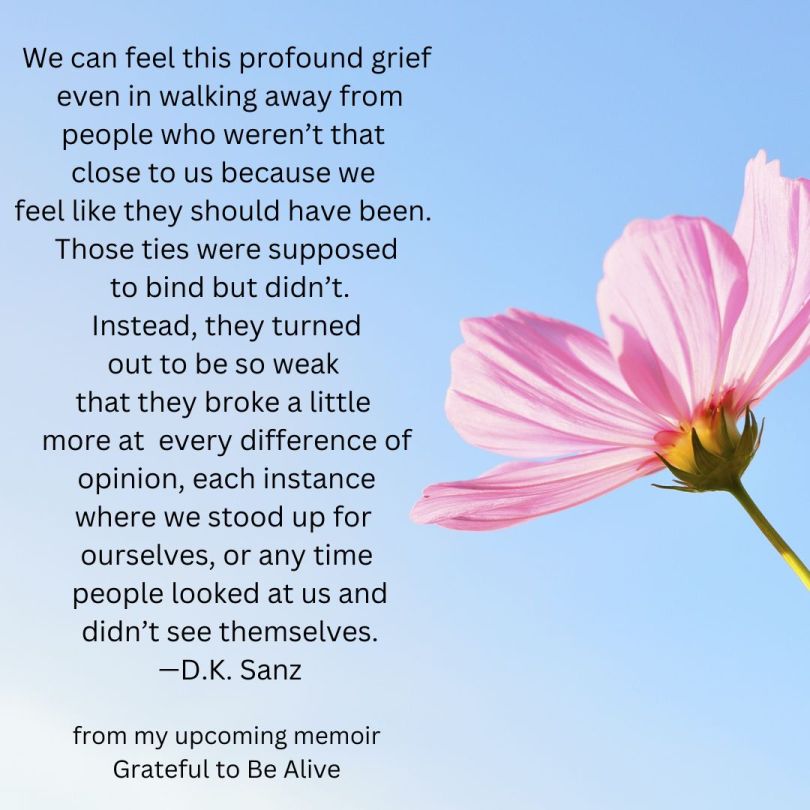
We can feel this profound grief even in walking away from people who weren’t that close to us because we feel like they should have been. Those ties were supposed to bind but didn’t. Instead, they turned out to be so weak that they broke a little more at every difference of opinion, each instance where we stood up for ourselves, or any time people looked at us and didn’t see themselves.

We certainly do a lot of grieving in life, and grieving does have its beauty. We can experience joy, happiness, sadness, and hurt; none are permanent states. These are moments that awaken us.

I’ve learned that the pain that follows in walking away is worth getting that toxicity out of your life. Even if they create a false narrative about you and make you out to be the devil incarnate, it’s still worth it. It will hurt less over time, or maybe it will always hurt a little, but you’ll be okay. You were brave enough to show up to this shitshow again and again. You tried to fit in. You tried to make it work. If it didn’t, well, love and acceptance await you elsewhere. In AA, I heard the slogan: You can’t heal in the same environment that made you sick. I believe that.

It’s important to realize we deserve to be happy. A few cherished loved ones are far better than dozens of people hanging on simply to make life difficult. We can’t fix or save everyone. We can’t always make things right.

To this day, there are people I’d love to drop a line to and ask how they’re doing or just to say, “I miss you.” One might ask themselves: What are safe topics we can discuss? Should we stick to a public forum in responding to one another rather than talking on the phone or by text? Can we support one another in ways that don’t involve us in their lives? I find these things helpful in dealing with others where caution may apply. It’s often the difference between reacting and responding. Realize you’re communicating with another vulnerable human being who likely has had their own trauma. They are not bulletproof.

As I’m sure everyone knows, you can love people to the moon and back even when your relationship with them is broken. You may forgive them and want the best for them while moving on without them. I’ve learned the best thing to do is keep sending them love and light, along with your inner hope for peace and the willingness for them to heal. I visualize it going to them in waves: I send you love. I wish you well. I wish you peace.

Sometimes, that’s all we can do. Even if you don’t buy into the “waves” thing, the exercise is intended to let go of any negative feelings.

Most importantly, though: We must forgive ourselves, as well. All we wanted was love.

*Excerpted from my forthcoming memoir, Grateful to Be Alive: My Road to Recovery from Addiction*

Heart/sand image by 愚木混株 Cdd20 from Pixabay