
HOW WOULD YOU DEFINE BEAUTY?

Beauty is not in the face; beauty is a light in the heart. – Khalil Gibran

It is time for parents to teach young people early on that in diversity there is beauty and there is strength. – Maya Angelou

COMING SOON!

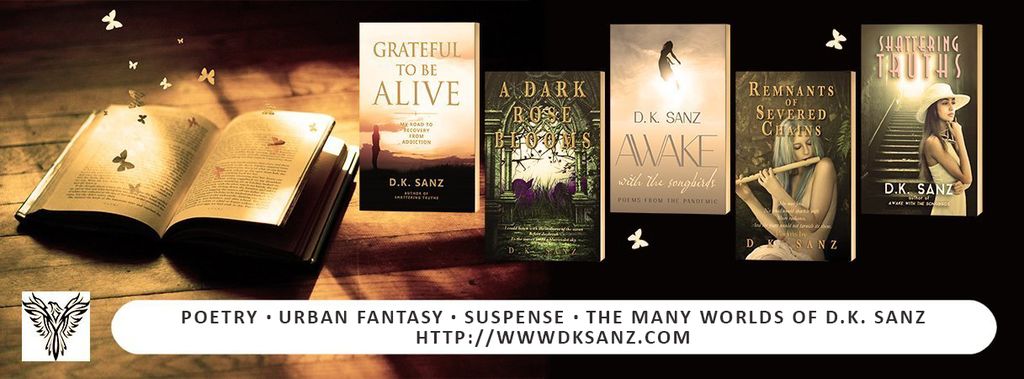
Grateful to Be Alive

My Road to Recovery from Addiction

by D.K. Sanz

Do unsettling truths bring harsh judgment? They do, but the price of denial is steep.

D.K. Sanz’s story begins in the drug-infested New York City streets of Woodside, Queens, during the tumultuous HIV/AIDS pandemic of the 80s and 90s. It offers a glimpse into how a now often-overlooked pandemic impacted Sanz’s nuclear family. 

From her earliest days, D.K. was the easily forgotten stranger, always a little out of sync with the rest of the world—a tough but naïve kid and aspiring writer. Her triumph over illness and addiction includes amusing anecdotes and nostalgic, heartwarming memories.

Grateful to be Alive delves deep into Sanz’s confessional self-sabotage, self-destruction, and the harrowing downward spiral she almost didn’t survive. Her never-before-told story ranges from recklessness and impudence to empathy, forgiveness, and love.

D.K. has since published several books, primarily poetry but also a novel, and she continues to work on sequels and an all-new fantasy series. You’ll find some of her poetry at the end of this book.

Whether struggling or not, you will find Grateful to Be Alive is a story of hope, defying insurmountable odds, finding joy, and a gradual transition toward authenticity and becoming the person D.K. always wanted to be.

“When you begin this book, you will not put it down. You will immediately be drawn into Sanz’s bold narrative of a woman, throughout her life, passing through “every forbidden door,” as she says of herself. It is a book of continual growth through experience, defeat, and triumph. The prose is swift, concise, full of irony, truth, and poise. You will not find a more startling, revealing memoir. Highly, highly recommended.” ~ Jason T. Masters

If you are interested in obtaining an ARC copy, please e-mail me at dksanz@yahoo.com.
Feature image at the top by Ana_J from Pixabay

THANK YOU FOR ENOUGH BEAUTY AND JOY

Image by James Wheeler from Pixabay

Despite mournful envy and

Dejected wrath,

We bask under blue skies,

Bewitching stars,

And mystical moons,

Loving rumbles of thunder,

Glistening raindrops,

And a hazy peaceful sunrise.

In the face of

Sorrowful greed,

We delight in magnificent mountains,

Bountiful oceans,

Turquoise lagoons,

Beautiful blossoms,

And the green, green grass

Of springtime.

Through raging anger,

Aching sadness,

We treasure radiant sunsets,

Seek marble courtyards,

Ancient architecture,

And splendid arched bridges.

We sing the praises of

Breathtaking falls.

Even crushed

And bewildered,

We are captivated by

Exquisite winged creatures,

Tropical forests,

And the critters we nurture.

We embrace the power in our divinity

And the superb magic of everything.

With every threat to the world

We belong to

And embrace,

We revel in books and dreams.

We’re mesmerized by

Otherworldly visions

And plentiful hues.

We cherish

The light in ever-curious

Truth seekers,

And are ever grateful

For smiles,

Rapturous affection,

Laughter,

And love.

by Kyrian Lyndon

Image by David Mark from Pixabay


When you do things from your soul, you feel a river moving in you, a joy. – Rumi

Find a place inside where there’s joy, and the joy will burn out the pain. – Joseph Campbell

I CAN TELL YOU, SHE HATED FLOWERS!

SHE HATED FLOWERS

She hated flowers, and I wondered why

That was;

When diamonds less radiant

Diminished her gloom,

And she delighted in the fragrance of her favorite perfume.

She hated that they withered and faded,

I thought;

That their petals broke loose,

And they barely hung on.

She hated that they were thrown away,

With every trace of them gone.

They were delicate and fragile like her,

I’d say;

The kind of thing

She felt so undeserving of.

It’s such taxing work for the weary,

Simply to nurture and love.

She clung to her own greenness and vigor,

I thought.

Exquisite as they were,

They brought too much sorrow;

She detested caring for those that,

Would not need her tomorrow.

She was too oppressed to provide refuge,

I found.

I heard heartbreaking stories,

Where she had it rough.

She did the best she could, I know,

But it was just never enough.

She is every bit like the flowers,

You know,

Warms your vulnerable heart,

With kindness and grace;

Brings happy tears to your eyes,

And the most joyful smile to your face!

She regales like a queen, and she stuns,

I say;

And I love her,

As I do those flowers she hates!

Some have penetrable walls, you know;

She has padlocked iron gates

Author: Kyrian Lyndon

Top feature image by Hong Zhang from Pixabay 

Black rose image by Larisa Koshkina from Pixabay

Purple rose image by GLady from Pixabay 

Orange flowers image by Larisa Koshkina from Pixabay

QUIET ETERNAL SONG – a short story by David Antrobus

Here is a short story written by a dear friend of mine, author/editor, David Antrobus. I just love the beauty of his writing and storytelling, and, so, I wanted to share it with you.

David Antrobus Posted On Saturday, December 5, 2020 At 10:53PM

She showed up every afternoon in the town square, her guitar and amp ready to display her bona fides, ready to dazzle. She used to hear god’s whisper but no longer. 

She was an auburn beauty, which was incidental, but her gathered ponytail and her classical vulpine face were assets, however the music came.

Yes, pretty hurts, but goddamn, it still had such currency.

“Pretty lady, I won’t rain on your parade, but this isn’t the place for you.”

The wolf had appeared from shadows beneath the chapel roof and the market awnings, and he smiled through tumultuous teeth and tried to dam his drool. Oh, he was hungry.

“The skies are clear and this isn’t my parade, Mr. Wolf,” she said. “This is a way station, and I come from elsewhere, but here I sing my truth.”

“Don’t push me, woman.” 

“I won’t. Instead I’ll make my music.”

And she did that. Splashes of half or quarter melodies, staccato squalls merging into dreamscape, arpeggios traipsing on ramparts of crenelated chords, spiralling into the darkest of wells and spinning into meadowlark updrafts. Distortion like the most shattered of mirrors, hot liquid globules and elastic spans of glass, a glittering haze of misted diamond. Her thumb like a hammer conjuring bass notes, rhythmic and sundry as coitus, her arachnid fingers a blur as lacquered nails plucked and glissandoed reflected layers of overlapping melody. And above it soared her voice, like the great mountain condor, effortless and buoyed by thermals.

The townsfolk gathered and grew in numbers, and they sometimes sang snippets that only augmented her song, and children danced, and then their mothers, and then, looking sheepish between themselves, their fathers. 

The wolf was humbled, reduced, his snout a wilted thing, his ears flat, the luxuriance of his tail now tucked. 

“Mr. Wolf, I won’t stay. I’ve done what I came for, and it’s always time to move on. What will you do?”

Cupping the town in its rough hands was a landscape of clear streams and falls, forests dappled by light and deer, skies that paraded like blue and white and grey ticker tape, crags and flats and the quiet eternal song of the land.

The wolf, who recognized the good as well, knew all this and loved it, but he felt thwarted. Her cello nape, her downy hollows, her female scent itself a taunt, and though he knew he was wrong, he let himself down.

“I will eat you; it’s how I’m made. It’s what I am. And you, my chestnut fawn, were made for this too.”

She sighed while she packed her instruments. Something in the faraway hills echoed and crackled like an exhaled nightmare. She wished she could love the wolf and receive his love in turn.

“You will do what you were made to do, Mr. Wolf. But you are not emblematic of your kind.”

The wolf was puzzled. He didn’t know what emblematic meant. And while he crunched her words like marrow from the bones of a lover, spurned and sickly as the plague-struck, the townsfolk moved in silence with their clubs and knives and systematically dismembered him, and hearing his last furious yowl she cried as she left town, her hardware hunched like a stigma on her back, the neck of her guitar a phallus, her keening cry a screech of corvid grief in the spent and airless afternoon.