ONE TOPIC WE CAN ALL RELATE TO

While I’m certainly not a professional, I’ve dealt with my share of narcissism throughout my life. Unfortunately, many people have endured far worse than what I’ve experienced, and some have been damaged beyond repair. Whatever we can do to help others toward the light in the darkness can mean the difference between their giving up and holding on.

My primary theory is that malignant narcissism is at the heart of the world’s dysfunction. I’m convinced that we’re dealing with the chaos of the world’s trauma, shame, and pain. It’s the gift that keeps on giving—with the worst possible repercussions, and it spreads through the universe like a poison. I believe this suffering, which leads to more suffering, is a cycle we can break with recognition, empathy, and a genuine desire to change.

So, I write this from the heart.

THE NARCISSISTS AMONG US

As you likely already know, narcissistic abusers can be parents, lovers, siblings, friends, aunts, uncles, grandparents, cousins, co-workers, employers, teachers, etc. Many of us are unwittingly drawn to them because of their familiarity. Awareness of malignant narcissism is critical since we have long-term contact with some of these people, which can amount to significant damage.

Reading and participating in narcissistic abuse recovery groups has taught me that there’s a difference between people with full-blown NPD and those who get “fleas” from narcissistic abuse—the latter having acquired the narcissistic abuser’s strategies and behaviors to cope and survive. There’s a spectrum, I believe, with varying degrees of impact. Some narcissistic abuse survivors don’t seem to exhibit any of the behavior they were subjected to, while others appear to have inherited every trace of it.

In short, while experiencing narcissistic abuse, we’re often dealing with a person’s trauma response to the abuse that they themselves experienced. Victims of narcissistic abuse can become so defensive that they, too, can become hurtful.

There was a time in my own life when despite the general empathy I had for others, my privileges made someone else’s struggle unrelatable to me. I took for granted that I had a good job and a career and that in my recovery from substance abuse, I wasn’t struggling. Relapse was not a temptation, let alone a threat. Many would say, well, you worked for those things. Yeah, I did, but the fact that I was able to shouldn’t have blinded me to the reality that it was hard and damn near impossible for those who didn’t have the advantages I had while growing up. My expectations of others at the time were unrealistically high, and I didn’t understand it when people fell short of meeting them.

I mentioned empathy a couple of times now because that’s an essential factor here. Empathy is what sets the recovering victim apart from a hopelessly disordered narcissist because it is empathy that makes us want to do better and play fair. We’re eventually willing to relinquish the narcissistic “payoffs” because we care about others. In my experience, I’ve found that as long as we have empathy for ourselves and others, we can rise above many of the character defects that burden us and make us a burden to others.

And to be fair, I’m not sure I’ve ever dealt with anyone who had a total lack of empathy, but they’re out there, and they’re dangerous.

NARCISSIST MOTIVATION

In my view, most narcissistic abusers do what they do out of insecurity, fear, and habit, and they can be oblivious to what’s causing them to act as they do.

These narcissists are ashamed of who they are, so they manufacture an image of who they want to be. That’s where the obsession with one’s self-image develops—and whatever the narcissist stands for becomes part of that façade. It becomes necessary for them to buy into and sell their superiority because, in the narcissist’s conscious or subconscious mind, there is no in-between when it comes to superiority and inferiority. Equal isn’t an option, and they don’t want anyone to see them as inferior. Damage control becomes a survival strategy and an automatic response to any threat to the ideology that comforts and, quite frankly, saves them.

In terms of fear, I think one thing narcissistic abusers often derive from their experiences is that there’s not enough of what’s good to go around, which may even be the case in their family environment. They then take that fear out into the world, believing, again—perhaps only subconsciously—that there’s a limited amount of love, attention, money, success, fame, and so on, no matter where they go. More for you means less for them; therefore, everything becomes a competition. With this mindset, it is difficult for them to genuinely support others and easy to fear that those “others” might succeed at their expense. You want them to root for you, but they’re more likely to sabotage you with discouragement and disinterest.

Perceived threats to a narcissistic abuser can be enviable traits, such as someone else’s popularity and influence, or even unenviable traits, such as an illness or disorder that another person may have to endure. People begin to pay more attention to the afflicted or popular ones, which can trigger an alarm for the narcissist. It compels them to redirect the attention they’re not getting so that the focus is back on them.

Sometimes, narcissistic abusers reject others simply for being different. There are circumstances where a child has mental or physical health issues, and a narcissistic individual will perceive that as shameful because they think it reflects negatively on them, or they see it as a weakness from which they must distance themselves. Sometimes, parents or relatives deny the problem or blame the child rather than support them. To a narcissist, that behavior is an affront to them. The main concern is, What will people think?

That was typical behavior hundreds of years ago—the result of clinical ignorance and/or superstition of the times, but it hasn’t entirely vanished all these years later, despite our society having a better understanding of these issues today.

For a dysfunctional narcissist, everyone in their family and circle of friends must be normal by their standards. Every member of their family or circle must also validate and reinforce whatever they think, say, and do in order to nurture the notion that their perception is always accurate. That’s crucial to them because their deepest fear is, if they are wrong about that, what else are they wrong about? And can they possibly be wrong about everything they believed to be true? They may not be ready to examine any of those possibilities.

Narcissistic abusers withhold support, validation, admiration, attention, and approval from those they perceive as threats or competition or anyone who challenges the reality they’ve constructed. They reject, bully, intimidate, humiliate, and kick perceived enemies when they’re down. These heartbreaking actions can crush a person’s spirit and leave them with paralyzing trauma and fear. Malignant narcissists often demonize someone because they don’t have the same power over that person that they so expertly wield over others.

Character assassination is most definitely in the narcissistic abuser’s wheelhouse, and they excel at it. They rewrite history, spin false narratives, mischaracterize, mock, and blame their chosen targets. There will be people within the narcissist’s social group playing both sides, as well, which becomes a never-ending drama. Too often, people want to be on the side they figure is winning, more popular, or simply more rewarding. They may even fear the narcissist and remain loyal rather than become another target. As victims of narcissistic abuse, we may also feel a sense of loyalty to the abusers, and we may wish to protect them. Denial becomes a method of survival for us, too. It doesn’t help that narcissistic abusers can be charming. We may find them so lovable and irresistible that we’re desperate to be wrong about them.

Nor does it help that none of us are perfect people, unwittingly allowing abusers to bring out the worst in us. When dealing with manipulative behavior, we sometimes make a bad situation worse with our reactions or simply by tripping over our own flaws and insecurities, thus taking the bait. (If I had a dollar for every ridiculous thing I’ve said in those circumstances—well, you get the idea.)

Sadly, too, we often genuinely love a narcissistic abuser and hope we can help them. It’s wise to remember that people who want to recover will do the work required to repair themselves. People who are not aspiring to change may not be willing or ready to examine themselves, acknowledge their mistakes, take responsibility, and begin the process of learning, growing, and healing. If they are not there yet, and you confront their behavior, they’ll likely act as if your question or statement is shocking, offensive, or absurd, and they’ll think you’re the one with the problem. The moment you put them on the defensive, it becomes even more critical to discredit you to themselves and their circle of family and friends.

It won’t matter what you say to them or how kind you are; your words will not move a narcissist who isn’t ready to change. You think you can meet them halfway, but if believing you, understanding you, and finding a way to co-exist peacefully with you doesn’t work with their agenda, they don’t compromise. Even if they care about and respect you, the extent to which they care has to be greater than their need to be perceived in the most flattering light.

The payoff they’ve gotten from selling their narrative is a lot to give up because they’d have to be willing to risk losing the false alter ego they created to survive. It’s easier for them to dehumanize a perceived enemy and rationalize that this person deserves their retaliation, no matter how vicious it is. They can’t afford to put themselves in your place and understand your emotional pain or see how they may be the ones who caused it.

Narcissistic abusers may call you selfish if you end the relationship or leave their group because they don’t realize what they’re asking you to do is tolerate their constant disrespect and abuse. But that’s okay. Those in their corner will agree with them that you’re selfish, and that’s okay, too. Maybe someday, they will be able to see things objectively, but don’t confuse someone you can save with someone you need to save yourself from.

IMPACT, SURVIVAL, AND CHANGE

I mentioned bullying above because bullying is a form of narcissistic abuse and can be debilitating for targets who are deeply connected to their emotions. These people may be strong in most situations, but bullying distorts their self-perception and leads to kindhearted people becoming more sensitive and insecure—often hating themselves. People don’t necessarily realize it when they contribute to the erosion of a child’s self-worth, but kids pay attention to how people treat them, and they get the message loud and clear. Abusers intentionally or unintentionally break our wings so that when we don’t fly, they can say they knew we never would or that we might have succeeded if only we’d listened to them.

Sadly, most of us already have an underlying fear that people won’t love us for who we are, which, through suffering from narcissistic abuse, gets distorted into the notion that no one will ever love us—period. That’s often one of the things people fear most in life, a fate worse even than death, and many young people out there are killing themselves for that. They fight to cope with one trauma after another until they reach a breaking point and can’t cope anymore, and then they shut down. The message is I’ve had enough; I can’t do this anymore. I’m out.

Often, when people feel that desperation, getting beyond thoughts of suicide is only the first hurdle. From there, it’s a long haul to reclaim themselves and their capacity to love.

That’s right. Our ability to love genuinely is also affected. We ask ourselves, What’s wrong with me? We can’t fix it or explain it, and we can’t stop it. We sometimes imagine we’re crazy or going crazy. We get completely lost and unsure about many things. Underneath it is a chronic sadness that never really subsides, and shame overwhelms us.

Awareness and acceptance are the first steps to most self-help, and that’s very much the case here. It takes time and requires ongoing self-maintenance, but we are generally more powerful than the obstacles that derail us. In this instance, I’m not talking about chemical imbalances or illnesses beyond anyone’s control; I’m talking about things that are beyond our control simply because we didn’t understand them at the time.

I advocate awareness because it’s easy for people to use our idiosyncrasies against us. Longtime endurance of narcissistic abuse leads us to question our judgment and sometimes acts to prove that the negative assessment of ourselves is correct. We may be attractive, intelligent, talented, or whatever, yet we fear we are inferior and unworthy of love and success because the people we want to love us—the narcissistic abusers—are incapable of genuine love. And if we are the reminder of their shame, they fear us as much as they fear the true selves they’ve buried deep.

We become more understanding as we become more aware. We learn to examine our actions and motives and not fear what we find. Again, we don’t have to be perfect, and none of us are. More important is the desire to recognize and correct hurtful behavior as we move forward.

When we choose to break the cycle, we learn to spot trouble from the get-go and avoid it. Even better, narcissistic abusers will tend to keep their distance because they’ll realize they’re not able to manipulate and control us.

The good news is we are always healing, as individuals, as friends, as a family, as a nation, and as a planet.  As part of that process, we continue to expand our consciousness, and we wake up every day one step closer to who we are meant to be—the best person we can be under our everyday circumstances.
Note:

This blog contains numerous excerpts from my forthcoming memoir, Grateful to Be Alive.

BOOK DETAILS:

Grateful to Be Alive:

My Road to Recovery from Addiction
By D.K. Sanz

Do unsettling truths bring harsh judgment? They do, but the price of denial is steep.

D.K. Sanz’s storybegins in the drug-infested New York City streets of Woodside, Queens, during the tumultuous HIV/AIDS pandemic of the 80s and 90s. It offers a glimpse into how a now often-overlooked pandemic impacted Sanz’s nuclear family. 

From her earliest days, Sanz was the easily forgotten stranger, always a little out of sync with the rest of the world—a tough but naive kid and aspiring writer.  Her triumph over illness and addiction includes amusing anecdotes and nostalgic, heartwarming memories.

Grateful to be Alive delves deep into Sanz’s confessional self-sabotage, self-destruction, and the harrowing downward spiral she almost didn’t survive. Her never-before-told story ranges from recklessness and impudence to empathy, forgiveness, and love.

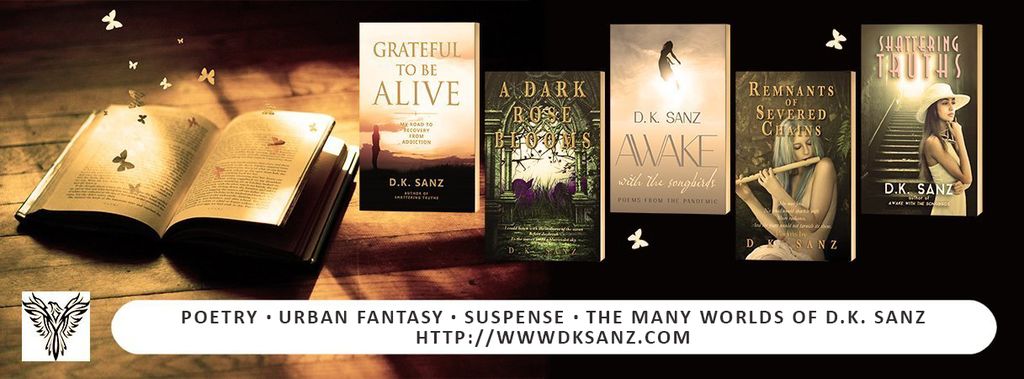
D.K. Sanz has since published several books, primarily poetry but also a novel, and she continues to work on sequels and an all-new fantasy series. You’ll find some of her poetry at the end of this book.

Whether struggling or not, you will find Grateful to Be Alive is a story of hope, of defying insurmountable odds, finding joy, and a gradual transition toward authenticity and becoming the person Sanz always wanted to be.

First ARC copy review:

“When you begin this book, you will not put it down. You will immediately be drawn into Sanz’s bold narrative of a woman, throughout her life, passing through “every forbidden door,” as she says of herself. It is a book of continual growth through experience, defeat, and triumph. The prose is swift, concise, full of irony, truth, and poise. You will not find a more startling, revealing memoir. Highly, highly recommended.” ~ J.T. Masters

If you are interested in obtaining an ARC copy, please e-mail me at dksanz@yahoo.com.

Photo credits:

Feature photo of narcissist shadow image by Thanks for your Likes from Pixabay 

Spirit nightmare dream image by Stefan Keller from Pixabay

Blindfolded woman in mirror image by Gerd Altmann from Pixabay 

Man in mysterious whisper image by Sam Williams from Pixabay

Dove/hands/peace/freedom image by Stefan Keller from Pixabay

WHAT ARE YOUR THOUGHTS ABOUT PAST LIVES?

When my son was little, sitting on his bed, he began a conversation with, “In my other life …”

I waited, but he stopped.

“In your other life, what?” I asked him.

“What?” he said.

“What about your other life?”

It confused him, and he didn’t remember saying what he said. 😕

Life seems to be full of “strange” incidents of that nature.

Many people relate to feeling homesick for a place they can only vaguely remember, and sometimes they can’t even remember it exactly, but they’re aware of it. Either way, they feel an aching, a longing they don’t quite understand.

Some people believe their partner is someone they’ve fallen in love with many times throughout the centuries, and they always manage to find each other. Others think they’ve continually searched for their twin flames and soulmates through one life after another. Or that they are born into this life with unfinished business. Then, of course, there are those déjà vu moments that don’t make any sense.

In my experience, the twin flames and soulmates seem about right, as does the unfinished business and weird déjà vu. So, I can’t discount any of the other stuff. 

I read Siddhartha by Herman Hesse when I was in my early twenties. You may know the book presents reincarnation as a necessary part of life. Over time, I’d also read a few suspenseful books that dealt with the same subject—Max Ehrlich’s The Reincarnation of Peter Proud and Frank De Felitta’s Audrey Rose. Both books have film versions, and Audrey Rose was supposedly a true story.

A friend of mine recently recommended Many Lives, Many Masters by Brian L. Weiss, M.D., which gives a therapist’s account of his sessions with a patient who eerily recalled past lives. Evidently, Dr. Weiss was pretty skeptical about the whole subject and ultimately became convinced by what he’d heard, so I look forward to reading that.

It’s fascinating stuff. The idea that we continually evolve has always made sense to me, and I could embrace the fact that it takes place over many lifetimes. Is the goal to get it right finally? And then what? Those are things I like to explore.

In making sense of the “continual evolving” theory, here’s what I’ve noticed.

We have people who can throw another human being in front of a train without conscience. We have people who can be oppressive and hateful. In the first instance, some will say that’s just someone who is mentally ill. But you can say that about many serial killers, too. Most people with mental illness don’t do things like that and wouldn’t want to hurt anyone. In fact, I believe people have to reach a level of depth before they even suspect there’s a mental problem or disorder they need to confront. They already know how life is supposed to be and are trying to cope. The others don’t seem to know or care how they should treat each other and behave.

Have you ever tried to have a conversation with someone who can’t even begin to comprehend that everyone deserves rights, dignity, and respect? Yeah.

Once I half-jokingly said to my son, “Maybe those people are here for the first time. You know, like when somebody is incredibly incompetent, and you think, first day?” It’s also similar to when we consider that a person who is so very young has a brain that’s still developing. (My son doesn’t like this theory for those I described above because he thinks it provides an excuse for people whose actions should never be justified.)

It may be an explanation, never a justification.

But I can’t say whether these people are in their first lives or not. Nor can I proclaim with certainty that I’ve had more than one life, but I can say that, in this particular life, I’ve learned so much, and I’m still learning.

The little jolts I’ve had, the moments of wondering if I’d been here before—well, I saved them for last because I’m still not sure it amounts to much.

There’s the fire thing. As a kid, I sprang into action to put out a fire that started in my sister’s room. Everyone had been asleep, but I was on it before others could fully awaken and realize what was happening. It happened two other times when I was a decade or so older. Once, someone had left candles unattended, and I, practically naked, leaped out of bed like Superman with the tall buildings and all, and it was actually quite funny. My boyfriend at the time laughed heartily, but I snuffed those flames out in a heartbeat.

Yes, I know, people put out fires all the time, especially firefighters. Many act quickly in a crisis. What strikes me is the feeling I’d get whenever faced with that situation. I had a fear of fire. It was an instant threat to me, signaling a violent urgency, but there was no fear or panic when I confronted it, only action.

Another time, while still a kid, I realized, during a crisis, that a person would not survive if I took one action instead of another. I had no way of knowing that, but I turned out to be right, and someone lived to see another day.

Many people would say, in both instances, it was God. Okay. I lack the evidence to dispute that, but obviously, there’s a lot of food for thought, as they say.

In childhood, I had a cousin about six years older than me. We hardly saw each other, but whenever we did, we couldn’t help feeling we’d always known each other. He was always incredibly familiar to me, and we talked as if we’d been friends forever. Again, it was about the feelings, not so much the idea, where you can say, so you just connected, okay, no big deal.

My conclusion is that I lean toward believing in reincarnation and will continue to look for more evidence of that.

In her memoir, Finding Me, the outstanding actress, Viola Davis, revealed her conversation with actor Will Smith. He’d asked her who she was (down deep) and admitted that he himself had been stuck in a place of childhood trauma. It helped her to realize where she was stuck, and, in reading that, I instantly knew what that place was for me. I’m not there anymore, but I was for many years. 

Viola and Will were talking about this lifetime, but isn’t it possible that people can get stuck in a place that has nothing to do with this life? Hmm …

If there is truth to these theories, we have more power than we realize, and hopefully, the end game is to promote an agenda of love over hate. 

Yes, maybe it’s that simple: love wins. 

Feature image at the top by Karin Henseler from Pixabay 

GRATEFUL TO CELEBRATE 27 YEARS OF SOBRIETY

You don’t have to be a lampshade-wearing drunk or fighting barroom drunk for drinking to be a potential problem. However, there was a time when I figured just backing off street drugs was the end of that forbidden road. I continued to drink alcohol—mainly a glass of champagne on birthdays or holidays.

Yes, well—abstaining from one drug and not another may work for some people, but I realized 27 years ago that it wouldn’t work for me. That’s when I decided I might as well stop drinking, too, and adhere to the twelve-step program.

It was only the beginning of my surrender.

In my first decade of sobriety, I didn’t fully understand why people said it’s “one day at a time” to infinity and beyond. If you’re not abusing alcohol or any other substance and haven’t even come close to relapsing in all these years, you’re good, right? You’ve got this. But that’s not how it works. Addiction, I learned, is a disease of the body, mind, and spirit, and emotional sobriety while abstaining is also ongoing one day at a time. 

On the emotional end, it’s been referred to as the “disease of the attitudes.” Still, I have to say most of us who’ve resorted to substance abuse come into recovery with fleas from narcissistic abuse, usually from people who were also living the aftermath of narcissistic abuse. On top of all that, many of us are trauma survivors who’ve dealt with physical, emotional, or sexual abuse—quite often all of those things.

Under these circumstances, we’ve co-opted the shame-based coping and survival skills of our abusers. They are skills that have kept us alive and emotionally intact while also putting us at significant risk over and over again. So, we’ve been wandering around doing things we weren’t aware of to block out the pain or create a pacifying illusion of safety. On some level of our consciousness, our needs seemed urgent, making us unusually vulnerable. We craved attention, validation, and praise, and that was another drug, a temporary fix whenever someone complied. It doesn’t work for long because, as with any other drug, the euphoria fades, and you remember the pain and torture of what you genuinely fear—that you’re not special or that no one loves or cares about you. Hence, we crave one fix after another.

We convince ourselves that certain relationships are about selflessness and love when they are more often tainted by our dysfunction. We may love people the best way we can, but it’s only as genuine as we are.

Whatever the deal is, addiction is an obsession. In its active state, it impairs our judgment and clouds our perception. It robs us of clarity which only returns and continues to improve with consistent physical and emotional sobriety. Meanwhile, the pressing urges of codependency will consistently override any willingness to be authentic. 

Addicts, for the most part, in our lifelong frenzy, attempting to survive the madness, may become con artists. Often, too, we lack empathy. We are self-obsessed and often unable to put ourselves in someone else’s place. We’ve lost the connection where we assimilate what others are experiencing. 

Without realizing it, we may become bullies with an eye out for any perceived threat, frequently compelled to do damage control. We’re fiercely determined to preserve our delusions and denials and protect our “secrets.” We attempt to control everything, including how others perceive us. So, drama is very much a part of our lives—waiting for the other shoe to drop, dreading it when the phone rings, an automatic response of, what now? And we don’t hold ourselves accountable for our actions. Instead of learning from our mistakes, we make excuses.

Despite having developed a shaky trust in others, we still trust the wrong people at times because those types are familiar to us. We form toxic relationships that can put us or keep us in dangerous situations with severe consequences. People inclined to use our fragility against us instinctively take advantage, and we will unintentionally draw them to us. Sometimes, they suffer from the same affliction, and their desperation is so great that they can’t discern beyond it. Neither can we.

The point is, we can abstain and still be a hot mess. When we come to our moment of surrender, we are broken and, yes, quite fragile in our vulnerability. Our self-esteem has been gutted. We feel unworthy of anything good. We lack the tools or coping skills for dealing with life on life’s terms. There continues to be unrelenting self-sabotage and self-loathing.

It’s a long road for us, and guilt continued to assuage me for many, many years. I cringed, embarrassed, remembering things I said or did, and it was hard for me to find any empathy for the person I was. My dearest friend, whom I’ve known for decades, reminded me not to be so hard on myself. “That girl was just trying to survive,” she said.

It’s hard to believe that merely trying to survive can be so catastrophic, but we’re not perfect. We struggle, and if we continue to put in the effort to become the best people we can be, we never stop getting better. The most important thing to me is continual recovery in every regard. As long as we’re still here, we have a chance to fight for our lives. I’ll never stop fighting, and I’m always grateful for another day to awaken and thrive.

This writing is an unedited excerpt from my new memoir, Grateful to Be Alive. For more details about the book, please read on.

Book description: 

Grateful to Be Alive

My Road to Recovery from Addiction

by D.K. Sanz

Do unsettling truths bring harsh judgment? They do, but the price of denial is steep.

D.K. Sanz’s story begins in the drug-infested New York City streets of Woodside, Queens, during the tumultuous HIV/AIDS pandemic of the 80s and 90s. It offers a glimpse into how a now often-overlooked pandemic impacted Sanz’s nuclear family. 

From her earliest days, D.K. was the easily forgotten stranger, always a little out of sync with the rest of the world—a tough but naïve kid and aspiring writer. Her triumph over illness and addiction includes amusing anecdotes and nostalgic, heartwarming memories.

Grateful to be Alive delves deep into Sanz’s confessional self-sabotage, self-destruction, and the harrowing downward spiral she almost didn’t survive. Her never-before-told story ranges from recklessness and impudence to empathy, forgiveness, and love.

D.K. has since published several books, primarily poetry but also a novel, and she continues to work on sequels and an all-new fantasy series. You’ll find some of her poetry at the end of this book.

Whether struggling or not, you will find Grateful to Be Alive is a story of hope, defying insurmountable odds, finding joy, and a gradual transition toward authenticity and becoming the person D.K. always wanted to be.

ARC Copies

For those unfamiliar, an ARC is an advanced reader copy provided before publication. Each recipient of an ARC intends to read and review the book. Reviews can be anywhere from one sentence to three or four paragraphs. Ideally, they should appear on Amazon and Goodreads the day the book comes out, likely in February. (I will notify you of the release date.) If it’s posted after that date, the sooner, the better, of course, but days or months later is still good. In other words, there is no rush.

Once given an ARC, you are under no obligation to read or review the book, but, at the same time, you wouldn’t want to request an ARC copy if that’s not your initial intention. In other words, if reading the book causes you to change your mind for any reason, there are no consequences, legal or otherwise.

ARCs are free. Currently, I have them available in Word or PDF formats. Eventually, they will be available on Kindle.

Reviews by ARC readers are posted on Amazon and, hopefully, Goodreads if the recipient has a Goodreads account.

ARC readers, unlike beta readers, are not expected to provide feedback to the author besides the public review, but feedback is certainly welcome.

To apply for an ARC, please e-mail me at dksanz@yahoo.com and answer the following questions:

1) Are you familiar with the author’s work? (Just curious, it’s okay if you’re not.)

2) Have you ever reviewed a book by this author?

3) Please briefly explain why this particular book would interest you.

4) Have you reviewed books or products before this request?

5) Do you have an Amazon account?

6) Do you have a Goodreads account?

Unfortunately, I may not be able to accommodate every request, but I thank you in advance for your interest.

SOME GREAT BOOKS I’VE READ THIS YEAR 😊

“You don’t have to burn books to destroy a culture.
Just get people to stop reading them.” – Ray Bradbury

I promised a few people I would blog about my year in reading.

My Goodreads goal was 52 books in 2022. Goodreads gives me credit here for having read 53 when last I checked, but I’m at 54 now. It takes them a bit to catch up. Most of the books are psychological thrillers, but there are a few other genres.

Here are the books I gave a five-star review:

Cruel: A Dark Romance Psych Thriller (A Necrosis of the Mind Duet 1) by [Trisha Wolfe]
Brain Damage: A twisted psychological thriller that will keep you guessing by [Freida McFadden]
Say Her Name by [Dreda Say Mitchell, Ryan Carter]
Want to Know a Secret?: A jaw-dropping psychological suspense thriller by [Freida McFadden]
Suicide Med: A gripping psychological thriller by [Freida McFadden]
The Housemaid: An absolutely addictive psychological thriller with a jaw-dropping twist by [Freida McFadden]
The Inmate: A gripping psychological thriller by [Freida McFadden]
Dead Against Her (Bree Taggert Book 5) by [Melinda Leigh]
Stone the Dead Crows (The Saeed Sharif Standalone Thrillers) by [Carrie Magillen]
When He's Not Here (The Saeed Sharif Standalone Thrillers) by [Carrie Magillen]
The Moonlight Child by [Karen McQuestion]
The Yoke and the Noose by [Kieran Higgins]
In the Waning Light by [Loreth Anne White]
Fear No Truth: A Faith McClellan Novel (The Faith McClellan Series Book 1) by [LynDee Walker]
DON'T LIE TO ME (Eva Rae Thomas Mystery Book 1) by [Willow Rose]
Dawn Girl: An absolutely gripping serial killer thriller (Tess Winnett) by [Leslie Wolfe]
Until I Met Her (Emma Fern Book 1) by [Natalie Barelli]
After He Killed Me (Emma Fern Book 2) by [Natalie Barelli]

Obviously, my favorite author of the year is Freida McFadden. There are many I’ve come to love, and Carrie Magillen is also at the top of that list.

I’ll post just a couple of my reviews.

Stone the Dead Crows (The Saeed Sharif Standalone Thrillers) by [Carrie Magillen]

This is the second book I’ve read by this author. The first, When He’s Not Here, I rated five stars.

Now, this one, I wasn’t sure what I’d rate it for a couple of reasons. First, I figured out exactly what would happen when I was about halfway through. (I wonder if that’s to my credit or if others would figure it out just as easily). Then again, is that so bad?

Second, the story deals with narcissistic and domestic abuse and gets into so much detail at a couple of pivotal moments that it almost seems to turn from fiction to non-fiction. Those subjects are important, though. I was into it, and, as far as I’m concerned, the more awareness created, the better.

The writing itself was beautiful, especially her descriptions of the surroundings. The story was riveting, and I couldn’t put it down. I read it all in just two days, and despite my figuring out the upcoming twists, the way she executed it was brilliant. So, near the end, I thought, hmm, should I give her a four or a five? Then I read the last few pages and HAD to give it a five. Well done! 

*****

Bloody brilliant! And I never say bloody anything. As disturbing and unsettling as it was in general, it was a well-written page turner, so cleverly constructed. I’m thirsty for more. 

A few words…

According to the literary statistics, 2022 has been a banner year for reading all around. That makes me happy not only because I’m a writer marketing books but because it’s a joy I want everyone to experience. For me, it’s been one of life’s greatest treasures, a passion I’ve felt privileged to have.

I have fond memories of trekking to the library with friends as a kid. On the way back, we bought french fries from the fish market, ate them along the way, and then settled on my stoop to read. It started with the Wizard of Oz, Alice in Wonderland, and Pinocchio, all so thrilling and magical.

I looked forward to ordering books during the school book sales. Narrowing it down to the books I wanted most was tough since my list was so long. On the day they arrived, the teacher arranged them in front of the classroom for all to see, and they were just beautiful with their gorgeous covers. I couldn’t wait! Then, holding the new books in my hands! It was a feeling I find hard to describe.

My English teacher introduced us to classics like Nicholas and Alexandria in high school. He took us to see A Christmas Carol at Radio City Music Hall, where my love for Charles Dickens began. I went on to Wuthering Heights and Pride and Prejudice with a burgeoning passion for 19th-century British literature. I loved gothic settings, too, time travel, and the days of the Roman Empire.

The truth is, no matter what you read, it’s bound to be good for you, and it’s easy when you find the genres and authors you love. In fact, like meditation or a day at the spa, reading is one of many ways to practice self-love. It takes you out of your world and into someone else’s mind, heart, and universe. You get comfortable in your favorite reading spot by the fire or under the covers. You relax with a book or even your phone. (I’m always reading on my iPhone Kindle.) You cast any troubles aside and simply surrender. It’s “you” time.

“What better occupation, really, than to spend the evening at the fireside with a book, with the wind beating on the windows and the lamp burning bright.” – Gustave Flaubert

For me, that escape to another time and place, learning about different people and things, is a lot of fun, like traveling in your mind. Whether you’re a writer or not, the stories inspire you. It’s good for the brain, warding off cognitive decline, and it often helps me fall asleep! 😉

Back in my school days, teachers would tell us we could increase our vocabulary by looking up words we didn’t know. That’s true as well.

And one of the best things about reading is the opportunity to empathize, even in a fictional situation.

When I became a parent, I often took my son to the library. At the time, I was looking for horror fiction, and he was looking for books about Jupiter!


It’s a wonderful thing.

“When I look back, I am so impressed again with the life-giving power of literature. If I were a young person today, trying to gain a sense of myself in the world, I would do that again by reading, just as I did when I was young.” – Maya Angelou

Image by Pezibear from Pixabay 

Reading nook in big library feature image by Prettysleepy from Pixabay 

Both Dickens Images by Prawny from Pixabay 

Wizard of Oz – Image by neotenist from Pixabay 

London Victorian era Lady dressed in black Image by Happy New Year from Pixabay 

Vintage Victorian ladies Image by Oberholster Venita from Pixabay 

Gothic romance – book, rose, black gk Image by Dorothe from Pixabay